Inside Spotify's Design System
How Spotify's design system goes bold and dark — its brand-green accent, expressive large-scale typography, and media-forward layouts, captured in an agent-readable DESIGN.md.
Some brands are recognizable by a logo. Spotify is recognizable by a single color. That specific, electric green — paired with deep black backgrounds and big, confident typography — is one of the most successful brand-color plays in consumer software. Publicly, Spotify is known for a design language that is bold, dark, and unapologetically media-forward: album art front and center, type that scales up to poster size, and an accent green that signals "play." When that language gets distilled into a DESIGN.md, an AI agent can reproduce the Spotify feel — the drama, the darkness, the green — from a single readable spec.
This piece breaks down how the Spotify DESIGN.md captures that bold, media-first aesthetic in tokens, and why those choices work so well for a product built around content rather than chrome. The full token set is on the Spotify design system page.
This piece interprets the product's publicly indexed DESIGN.md and brand aesthetics; it is not affiliated with or endorsed by the companies named.
Key Takeaways
- One color does the branding. The DESIGN.md captures Spotify's electric brand green as the single, unmistakable accent against an otherwise dark, neutral system.
- Dark is the stage, not the theme. Deep backgrounds exist to make album art and content pop — the interface gets out of the way of the media.
- Typography goes big and expressive. Large, confident headings give the product its editorial, poster-like energy.
- Content is the hero. The system is media-forward by design — UI chrome is minimal so artwork and playlists carry the visual weight.
- An agent can reproduce the drama. Feed the DESIGN.md to a coding agent and you get dark, green-accented, content-first UI — the point of how agents build on-brand UIs.
What Makes Spotify's Design Feel Bold?
Boldness in design usually comes from one of two places: loud color or loud type. Spotify uses both, but disciplined. The DESIGN.md captures a system where the background recedes to deep near-black, the accent green commands attention, and typography scales up dramatically for headings and section titles. The combination reads as confident and editorial — closer to a music magazine than a settings panel.
Crucially, the boldness is concentrated. Most of the interface is calm dark neutrals; the drama is reserved for the moments that matter — the play button, a featured playlist, a now-playing screen. This rationing is what keeps "bold" from tipping into "noisy," and it's the kind of judgment a design token spec is built to encode so an agent doesn't over-apply the accent.
The Color System: Dark Canvas, Electric Green
Spotify's palette is built on contrast. The DESIGN.md captures a deep, near-black background — a true stage — with layered dark surfaces for cards and panels. Against that darkness sits the brand's signature green, a vivid, saturated hue that has become synonymous with the play action and the brand itself.
The green is used with care. It marks primary actions (play, follow, save), active states, and brand moments — never as decoration. Foreground text stays in clean off-whites and grays, keeping focus on content rather than UI. This is the same restraint logic you'll find across well-built dev-tool design systems, but applied to a consumer, media-first context: the dark canvas exists so that the green and the album artwork can do the talking.
Typography: Editorial and Expressive
If Stripe spends its typography budget on precision, Spotify spends it on scale. The DESIGN.md captures a clean, modern sans-serif with a wide type scale — body text stays readable, but headings and titles go large, bold, and confident. This editorial sizing gives screens their poster-like presence: a featured playlist title reads like a magazine cover, not a form label.
Weight is used decisively. Bold headings, regular body, and clear hierarchy let the eye move from "what's featured" to "what's in it" without friction. For an agent, getting this scale right is what separates a generic dark UI from one that feels genuinely Spotify — which is why a typography system for AI UIs belongs in the spec, not in an agent's defaults.
How Does a Media-Forward System Differ?
Most product design systems are built around chrome — buttons, forms, navigation. Spotify's is built around content. The DESIGN.md reflects this: components are deliberately understated so that album art, cover images, and artwork become the dominant visual elements. Cards are essentially frames for imagery. Spacing is generous enough to let media breathe.
This inversion — content loud, UI quiet — is the defining trait. An agent building a "music library grid" with the Spotify spec should produce a layout where the artwork dominates and the controls recede. That's a specific instruction the DESIGN.md makes explicit, because an agent's default instinct is to make the chrome prominent.
Token Reference
| Token | Value / Direction | Role |
|---|---|---|
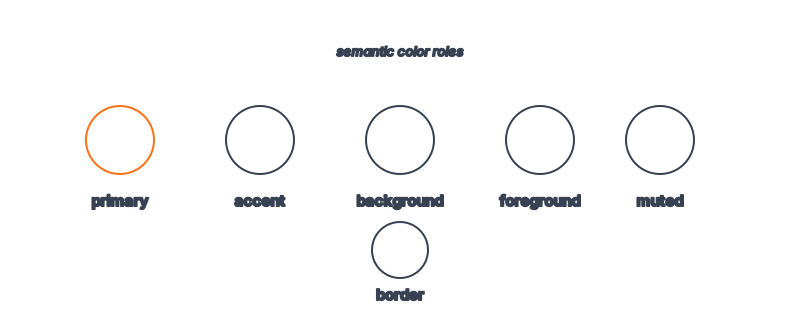
| Background | Deep near-black | The stage; makes media pop |
| Surface | Layered dark grays | Cards, panels, depth |
| Accent | Electric brand green | Play, primary actions, brand moments |
| Foreground | Off-white / gray | Clean, content-deferring text |
| Font family | Modern sans-serif | Editorial, confident |
| Heading scale | Large / expressive | Poster-like presence |
| Heading weight | Bold | Decisive hierarchy |
| Radius | Soft / medium | Modern, frame-like cards |
| Spacing | Generous | Lets artwork breathe |
Feeding the Spotify DESIGN.md to an Agent
The payoff is the same as with any Stitch-style design system: the spec turns brand intent into machine-reproducible output. Prompt a coding agent with "build a now-playing screen" plus the Spotify DESIGN.md, and the deep dark canvas, the rationed green play control, the oversized track title, and the artwork-forward layout all emerge by default. The agent reasons inside Spotify's token boundary instead of guessing.
It also means an agent can produce a whole family of screens — library, search, playlist, now-playing — that all feel like one product. That consistency at machine speed is the quiet superpower here. See the same pattern across other brands in our tour of 135 design systems.
Frequently Asked Questions
What makes Spotify's green so recognizable?
It's a single, highly saturated brand color used consistently and sparingly against dark neutrals. The DESIGN.md encodes it as the primary accent — reserved for play, primary actions, and brand moments — which is exactly what makes it stand out.
Is this an official Spotify design file?
No. The Spotify DESIGN.md indexed on aiskill.market interprets Spotify's publicly observable design language. It is not affiliated with or endorsed by Spotify.
Why is Spotify dark by default?
Because the product is media-forward. A deep dark canvas makes album art and cover imagery pop, letting content carry the visual weight while the UI recedes.
Can an agent reproduce the Spotify look from the spec?
Yes, to a strong degree. The combination of dark canvas, electric green accent, large expressive headings, and artwork-forward layouts is precisely what a DESIGN.md captures — see how agents build on-brand UIs.
Where can I see the actual tokens?
The Spotify design system page lists the full token set and component guidance, ready to feed to an agent.
Browse 135+ agent-ready design systems in the Designs category, or explore the full skill catalog at aiskill.market.