Design Tokens Explained for AI Agents
Design tokens are named, reusable values for color, type, spacing, and radii. Here's what they are and how AI agents consume them to build on-brand UIs.
When a designer says "use the brand blue," a human knows what to do — they've seen it, they have a swatch, they'll match it by eye. When you say the same thing to an AI agent, it picks a blue. Maybe a reasonable one. Probably not your blue. The gap between "the brand blue" and #635BFF is the entire reason design tokens exist, and it's the single most important concept to understand if you want agents to produce on-brand work.
A design token is a named, reusable value that represents one design decision — a color, a font size, a spacing step, a corner radius. Instead of scattering #635BFF across forty component files, you name it once (color.primary) and reference the name everywhere. Tokens decouple the decision from the implementation, which is exactly the property an AI agent needs: it reads a named value and applies it deterministically, with no guessing.
Key Takeaways
- A design token is a named, reusable value —
primary: "#635BFF",baseSize: "14px"— that captures one design decision and decouples it from code. - Tokens are what make a DESIGN.md file agent-readable — the token block is the half an agent applies directly.
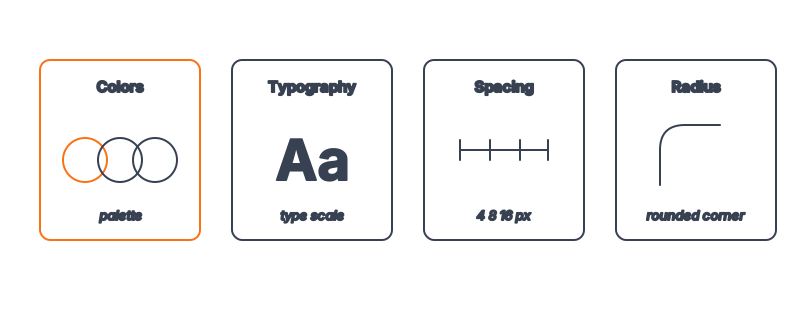
- Four families cover most UIs: color, typography, spacing, and radii. Get these right and an agent can build the rest.
- Tokens beat prose for precision. "A calm blue" is ambiguous;
#635BFFis not. Agents need the exact value to stay on-brand. - The W3C Design Tokens Community Group is standardizing the format, which is why the same tokens travel across tools and agents.
What exactly is a design token?
A token is a key-value pair where the key is a stable, semantic name and the value is the concrete design decision. color.primary maps to #635BFF. spacing.md maps to 16px. radius.button maps to 8px. The name is what you reference in your design system and your prompts; the value is what eventually renders.
The power is in the indirection. If your brand blue shifts from #635BFF to #5A52E0, you change one token value and every reference updates. Nothing hardcodes the hex. This is the same principle the W3C Design Tokens Community Group formalizes in its specification: a token is a named entity that holds a value, optionally with type and metadata, so it can travel between design tools, codebases, and — increasingly — AI agents.
The four token families an agent needs
You don't need a thousand tokens to get on-brand output. You need four families done well.
Color is the most visible. At minimum: a primary, a background, a surface, and a text color, plus accents and semantic colors (success, warning, error). The agent uses these for everything from button fills to text contrast.
Typography is a cluster, not a single value. A typography token block specifies fontFamily, baseSize, weights, lineHeight, and letterSpacing. Together these define the type system's character — Discord's larger base size for "always-on" readability versus Amazon Global's compact type built for buy-now intent. We go deeper in typography systems for AI UIs.
Spacing is the rhythm. Most systems define a base unit (often 4px) and a scale built from it — 4, 8, 12, 16, 24, 32, 48. The agent uses these for padding, gaps, and margins, which is what keeps generated layouts feeling consistent instead of arbitrary.
Radii are the corners. A rounded block typically separates button, card, and input because they often differ. This one family does more for "brand feel" than its size suggests — sharp corners read as technical and precise, soft corners as friendly and approachable. A fintech tool and a consumer app can share the same blue and the same font yet feel completely different on radii alone, which is why agents that ignore this token tend to land in an uncanny middle ground that belongs to no brand in particular.
| Token family | Example token | Value | What it controls |
|---|---|---|---|
| Color | color.primary | #635BFF | Fills, accents, links |
| Typography | typography.baseSize | 14px | Body text scale |
| Spacing | spacing.md | 16px | Padding, gaps, margins |
| Radii | rounded.button | 8px | Corner softness |
How does an agent consume tokens?
An agent reads tokens from a structured block — usually the YAML half of a DESIGN.md — and treats them as ground truth. When you ask it to build a primary button, it doesn't invent a color; it looks up color.primary, applies rounded.button for the corners, and pulls spacing values for padding. The output is reproducible because the inputs are explicit.
This is the difference between "vibes" and "values." A prose description — "use a trustworthy blue with comfortable padding" — leaves the agent to interpret trustworthy and comfortable. A token block leaves nothing to interpret. The agent that reads color.primary: "#635BFF" and spacing.md: "16px" produces the same button every time, and it's your button.
Reproducibility is the underrated benefit here. Because the inputs are explicit named values, two different agent sessions — or two different teammates prompting the same agent — converge on identical output. The button you generate today matches the one your colleague generates next week, with no design review needed to reconcile them. That consistency is something prose-based instructions can never guarantee, because every interpretation of "comfortable padding" drifts a little, and the drift compounds across a codebase.
Why named values beat prose for agents
There's a temptation to write design instructions as descriptive paragraphs because that's how we talk to humans. Resist it for the token layer. Prose is ambiguous by nature, and ambiguity is exactly what produces generic, AI-looking output. The agent fills ambiguity with the average of its training data.
The right division of labor: tokens carry the precise values, and markdown rationale carries the judgment about when to use them. "Reserve color.accent for a single primary action per screen" combines a named value with a usage rule, and that's a sentence an agent can both parse and respect. Values for precision, prose for intent — that's the recipe a good DESIGN.md follows.
Frequently Asked Questions
Are design tokens specific to AI agents?
No. Tokens predate agents by years — they originated in design systems to keep human teams consistent. What's new is that agents are now first-class consumers of tokens, which makes a structured, named token block more valuable than ever.
How many tokens do I need?
Fewer than you'd think. A solid color set, a typography block, a spacing scale, and a radii set will carry most products. Start minimal and add tokens only when a real inconsistency forces the issue.
What format should tokens be in?
YAML or JSON for the structured block — anything an agent parses deterministically. The W3C Design Tokens spec defines a JSON format, but for a DESIGN.md, readable YAML is common and works well.
Can I extract tokens from an existing app?
Yes. Tools and skills can read a codebase and surface the colors, sizes, and spacing already in use, which becomes the starting point for your token block. From there you refine it into an intentional system.
Do tokens replace my CSS variables?
They sit upstream of them. Your CSS variables are one implementation of your tokens. The token block in a DESIGN.md is the source of truth an agent reads to generate code that defines those variables correctly.
Browse 135+ agent-ready design systems in the Designs category, or explore the full skill catalog at aiskill.market.