Why AI Output Needs DESIGN.md
Without design context, AI agents produce generic, AI-looking UIs. A DESIGN.md gives them the colors, type, and spacing to build on-brand work instead.
You can spot AI-generated UI from across the room now. There's a look: a purple-to-blue gradient hero, rounded corners somewhere between "pill" and "card" with no apparent logic, a sans-serif that's whatever the framework defaulted to, and spacing that's almost consistent. It's competent. It's also instantly, depressingly generic — the visual equivalent of a stock photo. And the reason isn't that the model is bad at design. It's that nobody gave the model anything to design toward.
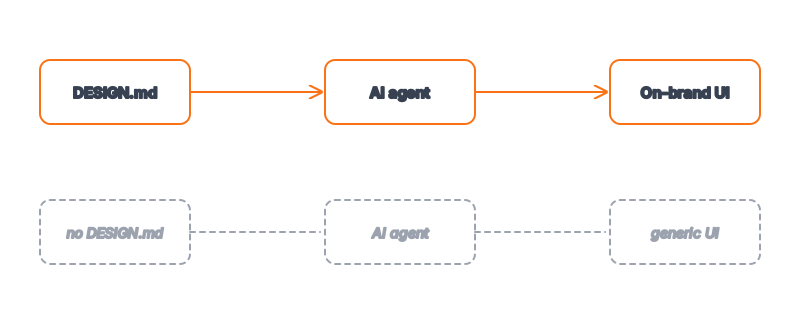
This is the core argument for DESIGN.md: an agent with no design context defaults to the average of everything it has seen, and the average is generic. Give it your colors, your type, your spacing, and your usage rules — in a form it can actually read — and the same model produces on-brand work. The fix isn't a better prompt or a bigger model. It's design context, packaged so the agent can apply it.
This piece interprets the publicly indexed DESIGN.md pattern and common brand aesthetics; it is not affiliated with or endorsed by any company named.
Key Takeaways
- Generic AI output is a context problem, not a capability problem. With no design spec, agents regress to the mean — see what design tokens actually are.
- A DESIGN.md supplies the missing context — exact colors, type, spacing, and radii the agent applies instead of guessing.
- The token block kills ambiguity.
primary: "#635BFF"produces your blue every time; "a nice blue" produces a different one every time. - Rationale carries the judgment prompts can't — when to use an accent, what to avoid — so output stays on-brand under variation.
- The cost is tiny. One file changes every UI an agent builds in your repo, with no model change or fine-tuning required.
Why does AI output look so generic by default?
A model generates the most probable output given its inputs. Ask for "a modern landing page" with no brand context, and the most probable result is a blend of the millions of modern landing pages in its training data — which is exactly why so much AI output converges on the same gradient, the same corners, the same type. The model isn't failing. It's giving you the statistical center of "modern landing page," and the center is generic by definition.
Brand is the opposite of generic. A brand is a specific set of choices that distinguish you from the average. Stripe's design language reads as "simultaneously technical and luxurious"; Humane built around "The Invisible Interface," a laser-red accent on black. Those are deliberate departures from the mean. An agent can't depart from a mean it was never told to depart from. You have to hand it the destination.
How a DESIGN.md changes the output
A DESIGN.md replaces the average with your specifics. The token block gives the agent exact values — color.primary, typography.baseSize, rounded.button, spacing scale — so it stops sampling "a blue" and starts applying your blue. The markdown rationale gives it the rules — reserve the accent for one action per screen, keep type compact for dense data views — so the application is correct, not just colorful.
The shift is immediate and total. The same prompt — "build me a settings page" — produces a generic page against an empty context and an on-brand page against a DESIGN.md. Nothing about the model changed. The only variable is whether the agent had a design spec to read. This is also why a DESIGN.md beats stuffing brand details into a one-off prompt: the prompt is forgotten next session, but the file persists and applies every time.
| Situation | What the agent does | Result |
|---|---|---|
| No design context | Samples the training-data average | Generic, "AI-looking" UI |
| Brand described in prose only | Interprets ambiguous adjectives | Right idea, wrong specifics |
| DESIGN.md token block + rationale | Applies exact values under rules | On-brand, reproducible UI |
Isn't this just prompt engineering?
It's the opposite of relying on prompt engineering, and that's the point. You could try to cram your entire design system into every prompt — every hex value, every spacing rule, every "don't" — and you'd burn tokens, forget half of it, and re-type it for every session. That doesn't scale and it doesn't persist.
A DESIGN.md externalizes the context into a durable artifact. You write the design system once, keep it in the repo, and point every agent session at it. The agent reads the same authoritative spec every time, which means the output is consistent across sessions and across teammates. This is the same lesson that drove llms.txt and AI-readable documentation — structured, persistent context beats ad-hoc prompting. The model is increasingly capable; the leverage now is in what context you feed it, which is the real new bottleneck.
The case for solo builders and small teams
The teams that benefit most from a DESIGN.md are the ones without a dedicated design function. A large company has designers who review every screen and catch the off-brand gradient before it ships. A solo builder shipping with Claude Code has no such safety net — the agent's output is the product. Generic output isn't a cosmetic problem for them; it's the difference between a product that looks like a real company built it and one that looks like a weekend AI experiment.
A single DESIGN.md is the cheapest design hire a solo builder can make. It encodes taste once and applies it forever, on every screen, without a designer in the loop for each one. You don't need to be a designer to write one — you can adapt an existing system from the Designs category, which indexes 135 of them, from the Spotify design system to the Stripe design system, and let your agent build against a proven aesthetic.
Frequently Asked Questions
Will a DESIGN.md make my AI output unique?
It makes it yours, which is what "unique" means in practice. The agent stops producing the generic average and starts producing output that matches your specific colors, type, and spacing.
Do I need a big, polished design system for this to help?
No. Even a minimal DESIGN.md — a handful of colors, a type block, a spacing scale — moves output off the generic mean. Start small and refine.
Why can't a more capable model just figure out my brand?
Capability isn't the constraint. A more capable model still defaults to the statistical center without context. It can't infer choices you never communicated — you have to supply them.
Does this work with any AI coding tool?
Yes. Because a DESIGN.md is plain markdown with a structured token block, any agent you can point at a file — Claude Code, Cursor, and others — can read and apply it.
How is a DESIGN.md different from just having good CSS?
Your CSS is the output; the DESIGN.md is the upstream spec the agent reads to generate correct CSS in the first place. Good CSS in your repo doesn't help an agent unless it reads and reuses it — a DESIGN.md makes the intent explicit and portable.
Browse 135+ agent-ready design systems in the Designs category, or explore the full skill catalog at aiskill.market.