Stitch-Style Design Systems Explained
Stitch-style design systems package design tokens and rationale into one agent-readable file. Here's Google's Stitch pattern and why a standard format matters.
If you've read about DESIGN.md files, you've probably seen them called "Stitch-style." The name isn't marketing — it points at a real, documented pattern for how AI agents should consume design context. As agents took over more of the UI-building work in 2026, a question kept coming up: what's the right shape for the design spec you hand them? "Stitch-style" is the answer that stuck, and it's worth understanding both where the name comes from and why a standard shape matters more than any individual design choice inside it.
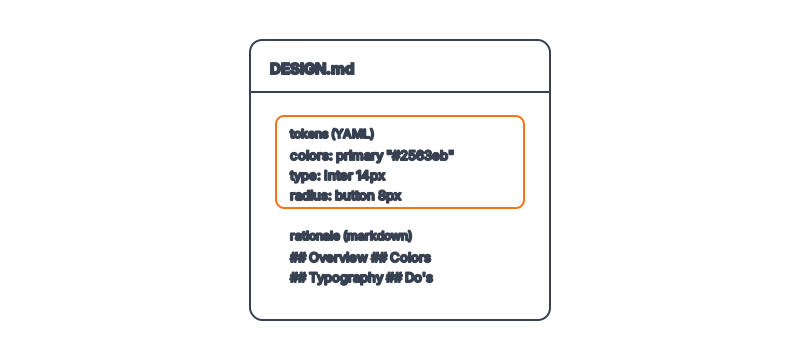
A Stitch-style design system is a design specification packaged for agent consumption: structured design tokens for the precise values, plus markdown rationale for the intent, in a single predictable file. The name traces to Google Stitch, Google's documented approach to agent-driven UI generation, where a structured design spec feeds the model so its output stays on-brand. The DESIGN.md format generalizes that idea into a plain file any tool can read.
Key Takeaways
- "Stitch-style" names a pattern, not a product — packaging design tokens plus rationale into one agent-readable spec, after Google's Stitch approach to agent UI generation.
- The pattern's payoff is a standard shape. When every design system lives in the same predictable structure, any agent knows where to look and how to apply it.
- Tokens carry precision, prose carries judgment — the same two-half structure a DESIGN.md file uses.
- A standard format is portable. A Stitch-style spec travels across Claude Code, Cursor, and whatever comes next, because nothing about it is proprietary.
- The format builds on design tokens as standardized by the W3C — named, reusable values an agent applies directly.
Where the Stitch pattern comes from
Google Stitch is Google's documented pattern for generating UIs with AI, where the model works from a structured design specification rather than from a vague prompt. The core insight is simple but easy to miss: an agent produces dramatically better, more on-brand UI when it's given a machine-readable design context up front, instead of being asked to infer brand from a sentence or two of prose. Google formalized that into a workflow; the community took the shape of the spec and applied it as a convention you can drop into any repository.
That convention is what "Stitch-style" describes. It's not Google's product running on your machine. It's the structure — token block plus rationale — that makes a design system legible to an agent. You can see the same lineage in Google's broader push toward design-to-code workflows and structured specs for AI tooling.
The shift it represents is worth naming plainly. For most of software history, the design spec was a communication artifact between humans — a designer told a developer what to build, and the spec was the handoff. A Stitch-style spec is a communication artifact between a human and a machine. The audience changed, so the optimal format changed with it: less narrative, more structure; less "here's the feeling," more "here are the exact values, and here's the one paragraph of judgment you need to apply them." Recognizing that the reader is now an agent is what makes the whole pattern click.
What makes a design system "Stitch-style"?
Three properties define the pattern.
First, structured tokens. The spec leads with a machine-parseable block of named values — colors, typography, spacing, radii — that the agent reads literally. No interpretation, no guessing. This is the design-token layer.
Second, markdown rationale. Below the tokens, prose explains intent: what the brand feels like, when to use each color, what mistakes to avoid. This is the half that carries judgment the tokens can't encode.
Third, a predictable shape. The sections appear in a recognizable order — Overview, Colors, Typography, Components, Layout, Do's and Don'ts. An agent that has seen one Stitch-style spec can read the next one without special instructions.
| Property | What it provides | Without it |
|---|---|---|
| Structured tokens | Exact, reproducible values | Agent guesses colors and sizes |
| Markdown rationale | Intent and usage rules | Right values, wrong application |
| Predictable shape | Any agent can parse it | Every spec needs custom handling |
Why does a standard format matter more than the content?
Here's the counterintuitive part: the standardization of the format matters as much as any design choice inside it. A brilliant design system locked in a bespoke format that only your team's tooling understands helps no agent but yours. A merely good design system in a Stitch-style file helps every agent that can read markdown.
Standardization buys you three things. Portability — the spec works in Claude Code today and the next agent tomorrow, because it's plain text with structured tokens. Composability — agents can read multiple specs, compare them, and learn from a corpus of them. Reviewability — the spec lives in your repo, shows up in pull requests, and gets versioned like code. None of that depends on the specific hex values you chose. It depends entirely on the shape.
This is why the W3C Design Tokens Community Group matters to the whole conversation. Standardizing the token format is the foundation; Stitch-style specs are the application layer that wraps those tokens in the rationale agents need.
How do you adopt the pattern?
Start with the tokens you already have — the colors, type, and spacing your product actually uses — and write them into a structured block. Then add the rationale: a one-line Overview that captures the brand's character, usage notes for each color, and a Do's and Don'ts section that names the mistakes you've seen agents make. Keep it in a DESIGN.md at the repo root so agents and humans both know where to find it.
If you don't want to start from scratch, the Designs category on aiskill.market indexes 135 Stitch-style design systems you can study or adapt — from the Stripe design system to the Raycast design system — each one a working example of the pattern. For a hands-on walkthrough, see how agents build on-brand UIs.
Frequently Asked Questions
Do I need to use Google Stitch to have a Stitch-style design system?
No. "Stitch-style" describes the shape of the spec, not the tool. You can write a Stitch-style DESIGN.md by hand and use it with any agent that reads files.
Is a Stitch-style design system the same as a DESIGN.md?
Effectively yes — a DESIGN.md is the file, and "Stitch-style" describes the structure it follows. The terms are often used interchangeably.
Why not just put my tokens in a JSON file?
You can, but you'd lose the rationale layer. The Stitch-style pattern pairs tokens with prose precisely because agents need both the values and the judgment about when to apply them.
How is this different from a traditional style guide?
A style guide targets humans and lives in a PDF or design tool. A Stitch-style spec targets agents and humans, with a token block an agent applies directly. See DESIGN.md vs a style guide.
Will the format keep working as agents change?
That's the main reason to adopt a standard shape. Because a Stitch-style spec is plain markdown with structured tokens, it stays portable across whatever agents you use now and later.
Browse 135+ agent-ready design systems in the Designs category, or explore the full skill catalog at aiskill.market.