Humane & the Invisible Interface
How Humane's design system imagines an interface with no screen — projection and voice, black canvas, white foreground, laser-red accent — captured in an agent-readable DESIGN.md.
Almost every design system in existence assumes a rectangle of glass you tap. Humane's begins by questioning the rectangle. Its AI Pin was built around a radical idea — "the invisible interface" — where the primary outputs are voice and a laser projection onto your palm, not a screen you stare at. Publicly, the brand is known for an aesthetic of extreme reduction: a black background, a white foreground, a single laser-red accent, and geometry that's either perfectly sharp or perfectly circular. When you encode that philosophy into a DESIGN.md, you get something unusual — a spec less about decorating a screen and more about defining what minimal information looks like when there's almost no surface to put it on.
This piece explores how the Humane DESIGN.md captures the invisible-interface philosophy in tokens, and why a near-screenless product forces such an unusually disciplined visual language. The full token set lives on the Humane design system page.
This piece interprets the product's publicly indexed DESIGN.md and brand aesthetics; it is not affiliated with or endorsed by the companies named.
Key Takeaways
- The interface is meant to disappear. The DESIGN.md captures a philosophy where voice and projection lead, and visual UI is the exception, not the default.
- Reduction is the brand. Black canvas, white foreground, and a single accent — there is almost nothing to remove, which is the point.
- Laser-red is the one signal. A single sharp accent color carries status, attention, and brand identity all at once.
- Geometry is absolute. Radii tend to extremes — perfectly sharp or perfectly circular — reinforcing a precise, intentional feel.
- It reframes what a DESIGN.md is for. When there's barely a screen, the spec governs clarity and restraint, the most extreme version of why AI output needs DESIGN.md.
What Is "The Invisible Interface"?
The premise is provocative: the best interface is the one you barely see. Instead of pulling you into a screen, Humane's AI Pin aimed to keep you in the world — answering by voice, projecting only the minimum onto your palm when a visual was truly necessary. The design philosophy follows directly. If a visual appears at all, it must be instantly legible, maximally reduced, and gone again quickly.
The DESIGN.md captures this as a hierarchy of restraint. Voice first. Projection second, and only when needed. Visual elements stripped to the absolute essentials — a glyph, a word, a status. There is no room for decoration because there is barely room for information. This is the design system as a discipline of subtraction, and it's a fascinating counterpoint to the screen-saturated systems we cover in our tour of 135 design systems.
The Color System: Black, White, and Laser-Red
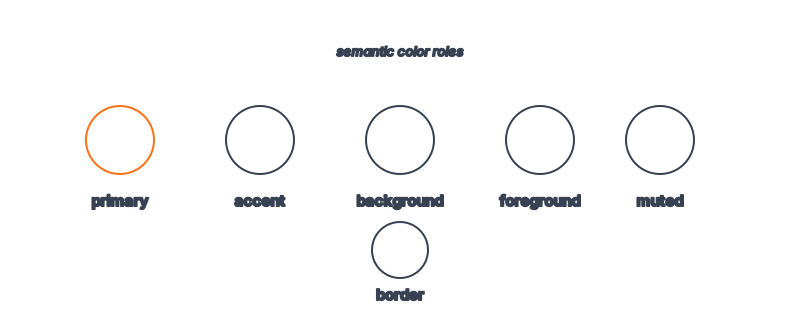
Humane's palette is the most reduced of any system we've profiled. The DESIGN.md captures a true-black background — appropriate for a projection where anything non-essential should simply be absent — with a pure white foreground for maximum contrast and legibility against skin or in low light. Between those two extremes sits a single accent: a sharp, laser-red.
That red does everything. It marks attention, status, recording, and brand presence all at once. In a system with no room for a palette of semantic colors, one accent has to carry the entire signaling load — and the choice of an intense red is deliberate, because a projected interface needs colors that read clearly in difficult lighting. This is color discipline taken to its logical endpoint, far past even the rationed accents you'd find in a fintech design system. Here there's essentially nothing left to ration.
Typography Under Extreme Constraint
When your display might be a projection on a palm, typography stops being about elegance and becomes about survival — can this be read, instantly, in motion, in bad light? The DESIGN.md captures a clean, geometric sans-serif chosen for maximum legibility at minimum size. There are no expressive headings, no editorial scale, no decorative weights. Type exists to deliver a word or a number and then disappear.
This is the inverse of a media-forward system. Where some brands spend their typography budget on poster-sized drama, Humane spends it on clarity under constraint. For an agent, the lesson is that "less type, larger, higher-contrast" is itself a brand decision — exactly the kind of nuance a typography system for AI UIs should preserve rather than smooth over.
Why Does the Geometry Go to Extremes?
Humane's radii are notable for avoiding the comfortable middle. The DESIGN.md captures geometry that tends toward absolutes — perfectly sharp corners or perfect circles, with little in between. This isn't arbitrary. Extreme geometry reads as intentional and precise; it signals a product that made deliberate choices rather than reaching for soft defaults. A perfect circle for a status indicator, a hard edge for a frame — each communicates confidence and reduction.
For an agent, this is a distinctive constraint to honor. The default instinct is the friendly medium radius. Humane's spec pushes the other way: commit to sharp or commit to circular, but don't drift toward the safe middle. That single instruction does a lot to make output feel like the brand. It's the clearest demonstration of why AI output needs a DESIGN.md — without it, an agent would soften exactly the thing that defines the aesthetic.
Token Reference
| Token | Value / Direction | Role |
|---|---|---|
| Background | True black | Projection-ready; non-essential = absent |
| Foreground | Pure white | Maximum contrast and legibility |
| Accent | Laser-red | The single signal: status, attention, brand |
| Font family | Geometric sans-serif | Legible at minimum size, in bad light |
| Type scale | Minimal / large | Deliver a word, then disappear |
| Radius | Sharp or perfect circle | Absolute geometry; intentional, precise |
| Spacing | Maximal restraint | Only the essential is shown |
| Interaction | Voice + projection first | Visual UI is the exception |
Feeding the Humane DESIGN.md to an Agent
What does it mean to hand a near-screenless design system to a coding agent? The output is necessarily different from a dashboard brief. Ask an agent for "a status display for an ambient device" with the Humane DESIGN.md, and you get a black canvas, a single white glyph or word, a laser-red status dot, and absolute geometry — no chrome, no clutter, nothing extra. The agent reasons inside a token boundary defined by subtraction.
That makes Humane a uniquely instructive case study in how agents build on-brand UIs: it proves that a design system's value isn't in how much it adds, but in how precisely it constrains. The most minimal spec can still be unmistakably a brand.
Frequently Asked Questions
What is the "invisible interface"?
It's Humane's design philosophy where voice and laser projection lead, and a visual screen is the exception rather than the default. The DESIGN.md captures this as a hierarchy of restraint — show the absolute minimum, then disappear.
Is this an official Humane design file?
No. The Humane DESIGN.md indexed on aiskill.market interprets Humane's publicly observable design language and brand aesthetics. It is not affiliated with or endorsed by Humane.
Why only black, white, and one accent?
Because a near-screenless, projection-based interface has no room for a full palette. The DESIGN.md reduces to a true-black canvas, a white foreground, and a single laser-red accent that carries all signaling at once.
Can an agent really use such a minimal spec?
Yes — and it's instructive precisely because it's minimal. The spec constrains hard toward subtraction and absolute geometry, which an agent honors to produce unmistakably on-brand, screenless-feeling output.
Where can I see the actual tokens?
The Humane design system page lists the full token set and design rationale, ready to feed to an agent.
Browse 135+ agent-ready design systems in the Designs category, or explore the full skill catalog at aiskill.market.