The 2026 Loop Engineering Toolchain
A survey of the 2026 loop engineering ecosystem: elorm Loops, explainx, awesome-agent-loops, continuous-claude, Gas Town, and the aiskill.market Loops channel.
A discipline is only as real as its tooling. Loop engineering crossed that threshold fast — within months of the term going mainstream, a genuine ecosystem appeared: directories of reusable loops, runners that wrap loops in pull requests, orchestrators that coordinate dozens of agents at once, and curated collections of the commands people were sharing on X. If you are starting out in mid-2026, the good news is you almost never need to invent a loop from scratch. The challenge is knowing which tool fits which job.
This is a field guide to the 2026 loop-engineering toolchain. It is organized by what each tool is for — discovering loops, running them autonomously, and orchestrating many at once — because that is how you will actually choose between them.
This piece reflects public discussion across X and engineering blogs as of June 2026; verify primary sources before relying on specifics.
Key Takeaways
- The toolchain splits into three jobs: discovering loops, running one autonomously, and orchestrating many — pick tools by job, not hype.
- Loop directories let you steal proven recipes instead of inventing exit conditions yourself — see 9 Agent Loops You Can Steal.
- continuous-claude wraps the Ralph technique in a PR-per-iteration workflow, covered in depth in Continuous Claude.
- Steve Yegge's "Gas Town" pushes orchestration to the extreme — 20–30 Claude Code instances coordinated by a "Mayor" agent.
- The aiskill.market Loops channel aggregates 152 loops from across the ecosystem, each with a goal, exit condition, iteration cap, and check command.
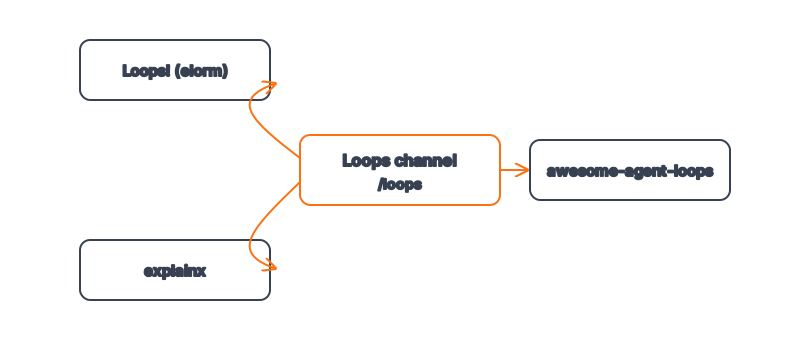
Discovering loops: the directories
The fastest way into loop engineering is to not write your own loop. Several directories now collect reusable loops you can adapt.
Loops! (loops.elorm.xyz) carries the tagline "Stop prompting. Start looping." and is one of the more visible curated collections. explainx.ai/loops hosts roughly 100 loops aimed at practical agent tasks. And awesome-agent-loops by serenakeyitan is a GitHub repo (CC-BY licensed) that curates /loop, /goal, and /schedule commands shared on X — useful precisely because it captures what working practitioners are actually running.
The aiskill.market Loops channel aggregates across these sources: 152 loops in total, drawing 41 from elorm, 99 from explainx, and 12 from the awesome-agent-loops collection. Each entry is normalized into the same shape — a goal, an exit condition, a max-iterations cap, a between-iterations check command, and a paste-ready kickoff prompt — so you can compare them on equal terms and grab one that fits. We walk through that collection in Inside the Loops Channel: 152 Recipes.
Running loops autonomously: the runners
Once you know what loop you want, you need something to run it without you babysitting each iteration.
The Claude Code primitives — /loop, /goal, and /schedule plus hooks, subagents, and worktree isolation — are the native foundation, and we break them down in /loop, /goal, /schedule in Claude Code. On top of those, a layer of purpose-built runners has emerged:
- continuous-claude (AnandChowdhary) implements the Ralph loop with a pull-request per iteration, so the agent's work arrives as reviewable PRs rather than a pile of raw commits. The repo is on GitHub.
- ralph-claude-code (frankbria) is another runner in the same family, packaging the fresh-context-each-iteration pattern.
- cobusgreyling/loop-engineering and mitsuhiko/agent-prompts collect patterns and prompt scaffolding for building loops.
These runners all share the same DNA — the Ralph technique of fresh context plus a durable spec — and differ mainly in how they package the output and what guardrails they bake in.
Beyond Claude Code: agent frameworks worth studying
Most of the tools above orbit Claude Code, but loop engineering is not Claude-specific — the same act-observe-decide-repeat machinery shows up in every serious agent framework, and reading their source is one of the fastest ways to understand harness design. Four are worth studying:
- Codex CLI — OpenAI's lightweight terminal coding agent. Its run loop and approval model are a clean reference for how a CLI agent iterates against a repo; OpenAI frames the surrounding discipline as harness engineering.
- OpenHands (formerly OpenDevin) — a full open-source agent platform with an explicit event-stream loop and sandboxed execution you can read end to end.
- PydanticAI — an agent framework built around typed, validated outputs, which makes the observe-and-verify step of a loop concrete rather than vibes.
- OpenAI Agents SDK — a lightweight framework for multi-agent workflows with built-in run loops, handoffs, and guardrails.
Studying how each structures its loop — where the exit condition lives, how state survives an iteration, how tool calls are validated — teaches the discipline faster than any single article. For the conceptual framing, Birgitta Böckeler's harness engineering for coding-agent users on martinfowler.com is the best overview.
What is "Gas Town" and why does it matter?
At the far end of the orchestration spectrum is Steve Yegge's "Gas Town" approach, which runs 20–30 Claude Code instances at once, coordinated by a "Mayor" agent that hands out work and integrates results. Where a single Ralph loop is one agent iterating in sequence, Gas Town is a fleet working in parallel under a coordinator.
Why does this matter beyond being a flashy demo? It points at the next problem in loop engineering: coordination. A single loop's hard problems are the exit condition and context management. A fleet's hard problems are dividing work without collisions, merging parallel changes, and keeping a coordinator from becoming a bottleneck. The toolchain is clearly evolving from "run one agent in a loop" toward "orchestrate many," and Gas Town is the loudest signal of that direction.
The toolchain at a glance
| Tool | Job | What it is | Best for |
|---|---|---|---|
| Loops! (elorm) | Discover | Curated loop directory ("Stop prompting. Start looping.") | Browsing proven recipes |
| explainx.ai/loops | Discover | ~100 practical loops | Task-specific loops |
| awesome-agent-loops | Discover | GitHub repo of X-sourced /loop /goal /schedule commands | What practitioners run |
| aiskill.market Loops | Discover | 152 normalized loops with check commands | Comparing loops on equal terms |
Claude Code /loop /goal /schedule | Run | Native loop primitives | Foundation for everything |
| continuous-claude | Run | Ralph loop, PR per iteration | Reviewable autonomous work |
| ralph-claude-code | Run | Ralph-pattern runner | Fresh-context autonomous runs |
| Gas Town (Yegge) | Orchestrate | 20–30 instances under a "Mayor" | Parallel fleet work |
| Codex CLI | Framework | OpenAI's terminal coding agent | Studying CLI agent loops |
| OpenHands | Framework | Open-source agent platform, event-stream loop | Reading a full runtime |
| PydanticAI | Framework | Typed-output agent framework | Validated observe/verify steps |
| OpenAI Agents SDK | Framework | Multi-agent workflow framework | Handoffs + guardrails |
How to choose
Start by asking which of the three jobs you are doing. If you do not yet know what loop you need, go to a directory — the Loops channel or one of its sources — and steal a proven recipe. If you have the loop and want it to run unattended, pick a runner: continuous-claude when you want PRs, the bare Claude Code primitives when you want maximum control. Only reach for fleet orchestration like Gas Town when a single agent genuinely cannot keep up and you are prepared to handle merge coordination.
Whatever you pick, the non-negotiables travel with you: every loop needs a goal, a verifiable exit condition, a max-iterations cap, and a check command. The tool changes; the discipline does not. Real, machine-checkable loops like build-until-green and ship-pr-until-green are the reference standard — clear goal, unambiguous exit, guardrails included.
Frequently Asked Questions
What is the loop engineering toolchain?
The set of tools that emerged in 2026 for building and running agent loops, falling into three groups: directories for discovering reusable loops (elorm, explainx, awesome-agent-loops, the aiskill.market Loops channel), runners for executing them autonomously (continuous-claude, ralph-claude-code, Claude Code primitives), and orchestrators for coordinating many agents (Gas Town).
What is continuous-claude?
A runner by AnandChowdhary that implements the Ralph technique with a pull request per iteration, so an agent's autonomous work arrives as reviewable PRs. The repo is on GitHub.
What is Gas Town?
Steve Yegge's approach to running 20–30 Claude Code instances simultaneously, coordinated by a "Mayor" agent that distributes work and integrates results. It represents the orchestration frontier of loop engineering — many agents in parallel rather than one in sequence.
Do I need any of these tools to start loop engineering?
No. You can run a loop with Claude Code's native /loop primitive or even a plain shell while-loop. The directories and runners save you time, but the core practice is tool-agnostic. Start simple, add tooling when you feel the friction.
Where can I find ready-made loops?
The aiskill.market Loops channel aggregates 152 loops from elorm, explainx, and awesome-agent-loops, each normalized with a goal, exit condition, iteration cap, check command, and paste-ready prompt. It is the fastest way to compare recipes side by side.
Browse 150+ ready-to-run agent loops in the Loops channel, or explore the full skill catalog at aiskill.market.