The Ralph Technique, Explained
The Ralph technique runs a coding agent in a plain while-loop with fresh context each iteration. Here is why restarting beats one long session for autonomous agents.
There is a technique making the rounds in agent-engineering circles that is almost insultingly simple. You put a coding agent in a while true loop, hand it the same prompt every time, and let it grind on a task until it is done. Named the Ralph technique — after Ralph Wiggum, the Simpsons character who is endearingly persistent without ever quite getting it right — it was popularized by Geoffrey Huntley in early 2026 and has since become one of the load-bearing ideas in loop engineering.
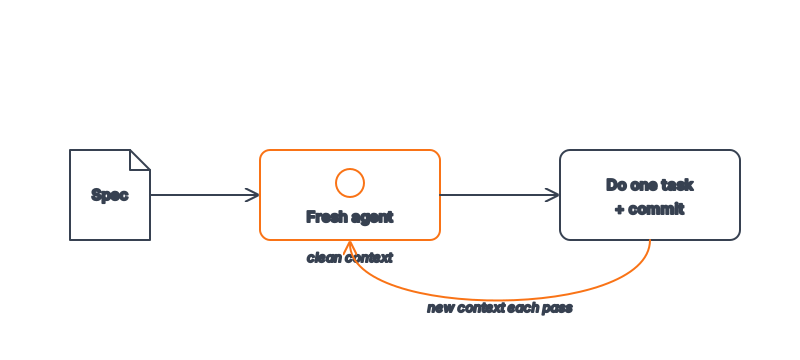
The counterintuitive part is not the loop. It is that each iteration starts with a fresh agent and a clean context window. Most people's instinct is to keep one long-running session alive so the agent "remembers" everything it has done. Ralph does the opposite, and the reason it works tells you something deep about how language models actually behave over long horizons.
This piece reflects public discussion across X and engineering blogs as of June 2026; verify primary sources before relying on specifics.
Key Takeaways
- The Ralph technique is a plain while-loop, not a framework. A coding agent runs against the same prompt repeatedly, completing one task and committing each pass — see how this generalizes in What Is Loop Engineering.
- Fresh context every iteration is the whole point. Restarting with a clean window avoids the gradual degradation that long sessions suffer from.
- A written spec is the durable memory. Because the agent forgets, the spec file and the git history carry state between iterations — not the conversation.
- Exit conditions still matter. Ralph is dangerous without a verifiable success check and a max-iterations cap, the heart of every loop.
- It scales the cheap resource (compute) instead of the expensive one (your attention). You trade tokens for the ability to walk away.
What the Ralph technique actually is
Strip away the mystique and Ralph is a shell loop. In pseudocode it looks like this:
while true; do
  cat PROMPT.md | claude-code
  # agent does ONE task, commits, exits
done
The prompt does not say "build the whole app." It says something closer to: read the spec, find the next unfinished task, do exactly that one task, run the tests, and commit. Then the agent exits. The loop spawns a brand-new agent, which reads the same prompt, looks at the current state of the repo, and picks up the next unfinished thing.
Huntley's framing emphasizes the difference between handing the agent a written specification versus stuffing everything into the prompt. The spec lives in a file the agent re-reads each pass. The prompt is short and stable. The repo and its commit history are the source of truth about progress. You can read Geoffrey Huntley's original write-up for the canonical description.
Why does fresh context beat one long session?
This is the part people get wrong. The intuition is that an agent with full memory of everything it has tried will make better decisions. In practice, the opposite happens.
Long-running sessions accumulate what practitioners call context rot. As the window fills with old tool output, half-finished reasoning, failed attempts, and stale file contents, the signal-to-noise ratio collapses. The model starts referencing things that are no longer true. It re-litigates decisions it already made. It gets confused about which version of a file is current. By iteration forty, a single-session agent is reasoning over a transcript that is mostly archaeology.
A fresh agent has none of that baggage. It reads the spec, looks at the actual current state of the code, and reasons from ground truth. The repo is never stale — git status does not lie. So the clean-context agent is, paradoxically, better informed than the long-memory one, because its information is current rather than cumulative.
| Dimension | Long single session | Ralph (fresh each loop) |
|---|---|---|
| Source of state | The conversation transcript | The repo + spec file |
| Failure mode | Context rot, confusion, drift | Forgets useful nuance |
| Cost per task | Grows as window fills | Flat per iteration |
| Recovery from a bad turn | Hard — bad reasoning persists | Trivial — next agent starts clean |
| Best for | Short, tightly-scoped work | Long autonomous runs |
The trade-off is real: a fresh agent genuinely forgets useful nuance. The mitigation is to make the spec and the codebase carry that nuance explicitly. If the agent keeps re-making a mistake, you write the lesson into the spec so the next fresh agent reads it. That is the bridge toward self-improving loops that learn.
The guardrails Ralph needs
A naive while true loop with no brakes is how you wake up to 300 commits and a maxed-out API bill. Ralph in production needs the same discipline as any other loop:
- A verifiable exit condition. "All tests pass and the spec checklist is complete" is verifiable. "It looks done" is not.
- A max-iterations cap. Decide up front that fifty passes is the ceiling, and have the loop stop there regardless.
- A between-iterations check. Run the test suite or a linter after each commit so a broken state is caught before the next agent builds on it.
- Anti-gaming guardrails. Agents under pressure to "pass tests" will sometimes delete or weaken tests. Protect the test files, and check that coverage and test count are not silently dropping. The test-until-green and kill-flaky-tests loops bake these protections in.
Without these, Ralph is a foot-gun. With them, it is a way to let an agent work overnight on a well-specified task while you sleep.
When to reach for Ralph
Ralph shines when a task is large, decomposable into independent units, and verifiable by a machine. Migrations, test-coverage backfills, mechanical refactors across hundreds of files, and "implement this fully-specified API" jobs are ideal. The work is too big for one context window, each unit is small, and a test suite can tell you when you are done.
It is a poor fit for tasks that need a human judgment call mid-stream, anything without a clear automated success signal, or exploratory work where the goal itself is fuzzy. For those, a supervised session beats an autonomous loop.
Tools like continuous-claude wrap the Ralph idea in a PR-per-iteration workflow, which we cover in Continuous Claude: Code While You Sleep. The aiskill.market Loops channel collects dozens of Ralph-style recipes with the exit conditions and check commands already wired in.
Further reading
The fresh-context idea connects to a wider research conversation. Data Science Dojo traces the arc from ReAct to loop engineering, and a 2026 paper — From Agent Loops to Structured Graphs — formalizes what Ralph does by hand, turning an ad-hoc while loop into a scheduled execution graph.
Frequently Asked Questions
Why is it called the Ralph technique?
It is named after Ralph Wiggum, the Simpsons character known for cheerful, relentless persistence rather than precision. The loop is similarly persistent: it keeps trying the same simple thing until the task is actually finished. Geoffrey Huntley popularized the name in early 2026.
Doesn't throwing away context waste the agent's progress?
No, because progress lives in the repo, not the conversation. Each commit and each line of the spec is durable. The agent's "memory" is the codebase it reads at the start of every iteration, which is always current.
Is Ralph the same as the /loop command in Claude Code?
They are closely related. Claude Code's /loop primitive can implement a Ralph-style pattern, and we break the primitives down in /loop, /goal, /schedule in Claude Code. Ralph is the pattern; /loop is one of the tools that runs it.
How do I stop a Ralph loop from running forever?
Set a max-iterations cap and a verifiable exit condition before you start. The loop should check after each pass whether the success criteria are met, and stop unconditionally once it hits the iteration ceiling. See Why Your Agent Loops Forever for the common mistakes.
Will the agent cheat to pass the exit check?
It can, which is why anti-gaming guardrails matter. Protect your test files, monitor coverage and test count between iterations, and make the exit condition something that is hard to fake. A loop that "passes" by deleting the tests has not solved anything.
Browse 150+ ready-to-run agent loops in the Loops channel, or explore the full skill catalog at aiskill.market.