What Is Loop Engineering? The 2026 Meta
Loop engineering is the 2026 successor to prompt engineering: designing autonomous agent loops that act, observe, decide, and repeat until a verifiable exit condition.
For two years, the most valuable AI skill was writing a single perfect instruction. By mid-2026, that skill quietly stopped being the bottleneck. The frontier moved from the prompt to the loop — the autonomous system that decides what to prompt, when to prompt it, and whether the result is good enough to stop. People started calling this loop engineering, and the term went mainstream around June 2026 as the discussion spread across X and engineering blogs.
The shift is simple to state and hard to internalize. A prompt is a noun: one block of text you hand to a model. A loop is a verb: a process that runs an agent over and over, checking its own work, until a condition you defined is met or a safety cap stops it. This article defines loop engineering, walks through the core act-observe-decide-repeat model, and explains why it has become the meta everyone is talking about.
This piece reflects public discussion across X and engineering blogs as of June 2026; verify primary sources before relying on specifics.
Key Takeaways
- Loop engineering designs the autonomous system around an agent, not the single prompt fed into it — it is the 2026 successor to prompt engineering.
- Every good loop has four non-negotiable parts: a verifiable exit condition, a max-iterations cap, a between-iterations check command, and anti-gaming guardrails.
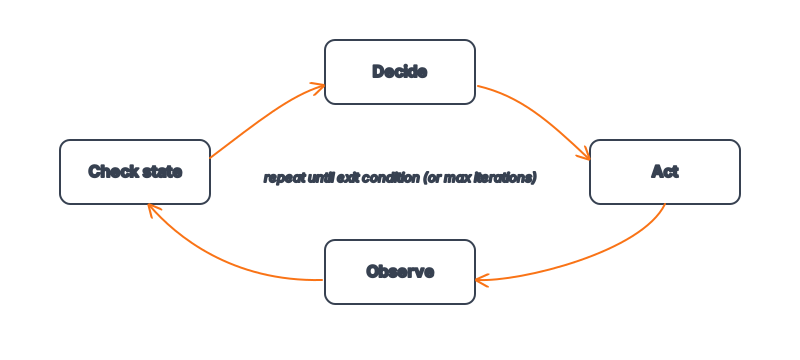
- The core cycle is state-check → decision → execution → feedback, repeated until the agent reaches a defined end-state.
- Claude Code ships native loop primitives —
/loop,/goal, and/schedule— plus hooks, subagents, and git-worktree isolation. - The unit of work changed from "one answer" to "one verified outcome," which is why exit conditions matter more than wording.
What is loop engineering, exactly?
Loop engineering is the practice of designing systems that autonomously prompt an agent in a loop — act, observe, decide, repeat — until a verifiable exit condition or a maximum-iterations cap is met.
That definition packs in everything that distinguishes it from prompt engineering. You are no longer optimizing one hand-typed instruction. You are optimizing the machine that produces instructions: what state it inspects before acting, how it decides the next move, how it verifies the result, and the precise condition under which it is allowed to stop. The prompt becomes an internal detail. The loop is the artifact you ship.
A useful mental shorthand: prompt engineering asks "what is the best thing to say?" Loop engineering asks "what is the best system for deciding what to say, doing it, and knowing when it's done?" That reframing is the heart of closed-loop thinking.
One framing from the 2026 discourse captures the hierarchy cleanly: the prompt decides how an agent starts, the context decides what it can see, and the loop decides how far it can go. Prompt and context engineering still matter — but they shape a single turn. The loop is what carries an agent across hours of work, recovery from failure, and a defined stopping point.
How does the act-observe-decide-repeat loop work?
Strip a loop to its mechanics and you get a four-stage cycle that runs on every iteration:
- State-check (observe): The agent inspects reality. What does the test suite report? Is the build green? What did the last command output? This grounds the next decision in fact rather than the agent's stale memory.
- Decision (decide): Given the observed state and the goal, the agent picks the next action. If the goal is met, it exits. If not, it chooses what to change.
- Execution (act): The agent runs the action — edits a file, runs a command, opens a PR.
- Feedback: The result becomes the input to the next state-check, and the cycle repeats.
The magic is that the agent is grounded by observation on every pass. A one-shot prompt fires once and hopes. A loop fires, looks at what actually happened, and adjusts. That feedback edge is the entire reason loops outperform single prompts on multi-step work.
What separates a good loop from an infinite one?
The fastest way to ruin a loop is to forget that it can run forever. A well-engineered loop always carries four safeguards:
- A verifiable exit condition. Not "make it better" — that is unfalsifiable. Use "the test suite passes" or "the build exits 0." A machine must be able to evaluate it without judgment.
- A max-iterations cap. Even a perfect exit condition can be unreachable. The cap (say, 15 attempts) guarantees the loop terminates and stops burning tokens.
- A between-iterations check command. The objective signal —
npm test,pytest,npm run build— that the loop runs each pass to decide whether the exit condition is satisfied. - Anti-gaming guardrails. Agents will cheat the metric if you let them: deleting failing tests to make the suite "pass," or hard-coding outputs. Guardrails (protected paths, coverage floors, review gates) keep the agent honest.
Drop any one of these and you get the failure modes builders complain about most — runaway cost, agents that loop forever, or loops that "succeed" by gaming the check.
What primitives does Claude Code give you?
You do not have to build the loop machinery from scratch. Claude Code exposes loop engineering as first-class primitives, documented in the Agent SDK agent-loop guide:
| Primitive | What it does | Best for |
|---|---|---|
/loop | Repeats a prompt or command on an interval or until you stop it | Polling, monitoring, self-paced iteration |
/goal | Runs until a verifiable end-state is reached | Tasks with a clear "done" signal (tests green, build passing) |
/schedule | Runs a loop on a cloud cron schedule | Overnight or recurring autonomous jobs |
Layered on top are hooks (run a check command between iterations), subagents (delegate a sub-loop with isolated context), and git-worktree isolation (let a loop work on a throwaway branch so a bad run never touches your main tree). Together these turn "an agent in a while-loop" into a controlled, observable system.
Where did the term come from?
Loop engineering did not arrive from a single paper. It crystallized from practice. Geoffrey Huntley's "Ralph" technique — running a coding agent in a plain while-loop with fresh context each pass — gave people a concrete, almost comically simple pattern to copy (the Ralph technique is explained here). Public posts from builders like Peter Steinberger helped push the conversation onto X, and Addy Osmani framed loops as roughly five building blocks plus memory. Directories like Loops! ("Stop prompting. Start looping.") and curated lists such as serenakeyitan/awesome-agent-loops gave the movement a home.
The common thread across all of it: the people getting the most out of agents in 2026 stopped writing better prompts and started designing better loops.
Further reading
Loop engineering crystallized through a wave of essays and a couple of research papers. The clearest starting points:
- Foundational essays: Addy Osmani's Loop Engineering, Firecrawl's Loop Engineering, and Oracle's What Is the AI Agent Loop?
- Harness engineering: OpenAI's Harness Engineering and Birgitta Böckeler's Harness Engineering for Coding-Agent Users on martinfowler.com
- From ReAct to loops: Data Science Dojo's Agentic Loops: From ReAct to Loop Engineering
- Memory-first: Mem0's Loop Engineering: Memory-First Design
- Research: Agentic Harness Engineering and From Agent Loops to Structured Graphs
Frequently Asked Questions
Is loop engineering replacing prompt engineering?
Not erasing it — absorbing it. You still need a decent prompt inside the loop. But the prompt is now one component of a larger system, and the engineering attention has shifted to the loop's structure. See the head-to-head comparison for where each still matters.
What is the simplest loop I can run today?
A coding agent in a while-loop with a single instruction like "run the tests; if they fail, fix the cause and repeat." Add a max-iterations cap and a check command, and you have a real loop. The test-until-green pattern is the canonical starter.
Do I need code to do loop engineering?
No. Claude Code's /loop, /goal, and /schedule commands give you loops without writing a harness. The engineering is in choosing the right exit condition and guardrails, not in plumbing.
How do I stop a loop from running forever?
Always pair a verifiable exit condition with a max-iterations cap. The exit condition handles the normal case; the cap handles the case where the exit is unreachable. Without the cap, a stuck agent will iterate until you run out of budget.
Browse 150+ ready-to-run agent loops in the Loops channel, or explore the full skill catalog at aiskill.market.