From One-Shot to Closed-Loop Thinking
A mental-model shift for 2026: moving from one-shot prompting to closed-loop systems built on feedback, verification, and bounded autonomy.
Most of us learned to use AI in open-loop mode without ever naming it. You type a request, you get a response, you read it, and the interaction ends. The model never finds out whether its answer worked. That's a one-shot system: fire once, hope, move on. It's how we used calculators, and for a while it's how we used LLMs.
Closed-loop thinking is a different posture entirely. Instead of asking "what's the best answer?" it asks "what's the system that produces an answer, checks it against reality, and corrects until it's right?" This is the mental model underneath loop engineering, and adopting it changes more than your tooling — it changes what you consider a finished unit of work. This essay is about making that shift deliberate.
This piece reflects public discussion across X and engineering blogs as of June 2026; verify primary sources before relying on specifics.
Key Takeaways
- One-shot thinking optimizes the answer; closed-loop thinking optimizes the system that verifies the answer — the core of loop engineering.
- A closed loop has a feedback edge — it observes its own output and feeds the result back in — which an open loop lacks entirely.
- The unit of finished work moves from "a response" to "a verified outcome," which is why exit conditions become central.
- Autonomy without bounds is recklessness; closed loops pair self-correction with a max-iterations cap and guardrails.
- The skill is engineering the feedback signal, because a loop becomes exactly as smart as the signal you give it.
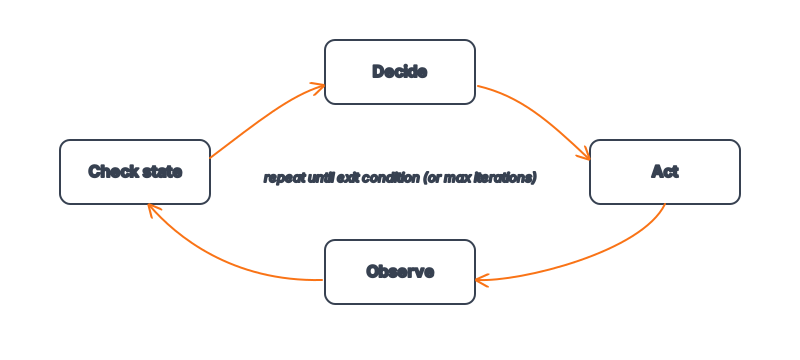
What is the difference between open-loop and closed-loop?
The terms come from control theory, and the distinction is precise. An open-loop system acts and never checks the result — a sprinkler on a timer waters the lawn whether it's raining or not. A closed-loop system measures its output and feeds that measurement back to adjust the next action — a thermostat reads the room temperature and decides whether to keep heating.
One-shot prompting is open-loop. You ask, the model answers, nobody measures whether the answer was right. Loop engineering is closed-loop. The agent acts, observes what actually happened (the test result, the build status, the command output), and uses that observation to decide its next move. The presence or absence of that feedback edge is the entire difference, and it's why a closed loop can grind through a multi-step task that a single prompt would fumble.
Why does the "unit of work" change?
This is the shift that sneaks up on people. In one-shot mode, the deliverable is a response — a chunk of text or code you then go validate yourself. In closed-loop mode, the deliverable is a verified outcome: not "here's some code," but "here's code, and the tests pass." The verification is no longer your separate manual step. It's part of the loop's definition.
That reframe is why the exit condition stops being an afterthought and becomes the design center. When the unit of work is a verified outcome, "what counts as verified?" is the first question you answer, not the last. Loops named after their condition — test-until-green, build-until-green — are closed-loop thinking made concrete: the verification is baked into the name.
How do you spot one-shot thinking in your own habits?
Closed-loop thinking is a muscle, and most of us default to one-shot out of habit. Some tells you're still thinking one-shot:
- You read every AI output line by line because nothing else is checking it.
- "Done" means "the model replied," not "a check confirmed it."
- You retype variations of the same request instead of writing a condition for success.
- You're present for the whole task, because the system can't tell good from bad without you.
The closed-loop alternative for each: let a check command judge correctness, define "done" as a passing condition, write the success criterion once, and step away while the loop self-corrects. The contrast with the prompt era is stark, and it's the same contrast at the center of prompt engineering is out, loops are in.
| Question | One-shot answer | Closed-loop answer |
|---|---|---|
| What's the deliverable? | A response | A verified outcome |
| Who checks it? | You, manually | The check command, automatically |
| When is it done? | When the model replies | When the exit condition is met |
| Where are you? | Watching every step | Setup and review only |
| What fails? | A wrong answer | A loop that needs a cap and guardrails |
Doesn't more autonomy mean more risk?
It would, if autonomy meant "no limits." But closed-loop thinking is not the same as letting an agent run wild. A real closed loop is bounded autonomy: it self-corrects toward a goal, but it carries a max-iterations cap so it can't run forever, a verifiable exit so it can't declare false victory, and guardrails so it can't game its own metric. Geoffrey Huntley's Ralph technique is a vivid example of bounded autonomy in practice — run the agent in a while-loop, but reset to fresh context each pass so old confusion can't compound (the Ralph technique is explained here). Tools like AnandChowdhary/continuous-claude wrap that loop in PRs, which adds a human review gate — bounded autonomy with a checkpoint. The autonomy is real; the recklessness is engineered out.
What does the shift demand of the engineer?
A different skill set. One-shot mastery was about phrasing. Closed-loop mastery is about designing the feedback signal. A loop is exactly as intelligent as the signal you hand it: feed it npm test and it converges on passing tests; feed it a vague "looks good" and it converges on nothing. Addy Osmani's framing of self-improving agents as building blocks plus memory lands here — the feedback is the building block that does the steering. Claude Code's /loop, /goal, and /schedule primitives (see the agent-loop guide) hand you the loop machinery; your job is to engineer the signal that points it somewhere true.
Frequently Asked Questions
Is closed-loop thinking only for coding?
No. Any task with a checkable outcome benefits — content that must pass a linter, data that must match a schema, a deploy that must pass a smoke test. The requirement isn't code; it's a verifiable signal.
How is this different from just "automation"?
Plain automation is often open-loop — it runs a fixed script regardless of results. Closed-loop systems observe their own output and adjust. The feedback edge is what makes it loop engineering rather than a cron job.
Where do I start if I've only ever done one-shot prompting?
Take one task you currently validate by hand and write down its success condition as a command. That single act — turning "looks done" into "this command exits 0" — is the first step from one-shot to closed-loop. Test-until-green is a gentle on-ramp.
Can closed-loop systems still go wrong?
Yes — that's why they need bounds. A closed loop with no cap can run forever; one with a weak signal can converge on the wrong thing or game its metric. The discipline of exit conditions is what keeps closed loops trustworthy.
Browse 150+ ready-to-run agent loops in the Loops channel, or explore the full skill catalog at aiskill.market.