Prompt Engineering Is Out. Loops Are In.
Why loop engineering replaced prompt engineering in 2026, and what changes for builders when the unit of work becomes an autonomous loop instead of a prompt.
There is a quiet humiliation in watching a skill you spent two years sharpening become a footnote. For a lot of builders, prompt engineering was that skill — the art of coaxing a model into a good answer with the right phrasing, the right examples, the right "think step by step." It worked. And in 2026 it stopped being the thing that matters most.
The reason is structural, not fashion. When agents can run themselves in a loop — act, observe, decide, repeat — the bottleneck moves off the sentence and onto the system. The provocative version of the claim, the one that lit up X in June 2026, is blunt: prompt engineering is out, loops are in. This essay argues why that framing is right, what actually changes for builders, and where the old skill still earns its keep.
This piece reflects public discussion across X and engineering blogs as of June 2026; verify primary sources before relying on specifics.
Key Takeaways
- The unit of work changed from a prompt to a loop — and that single shift reorganizes everything downstream, as loop engineering explains.
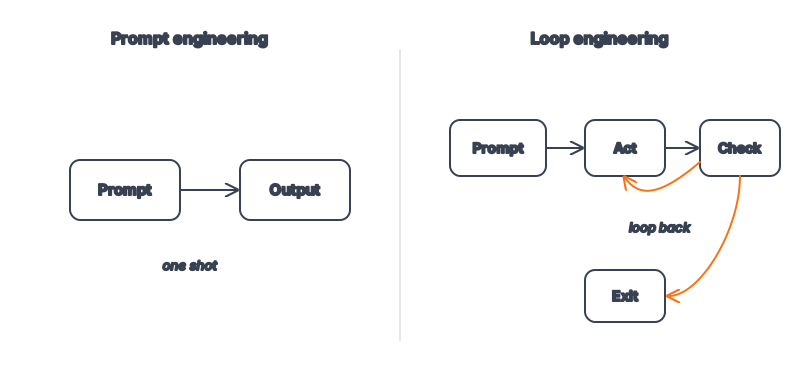
- Prompt engineering optimizes one hand-typed instruction; loop engineering optimizes the autonomous system that decides what to prompt, when, and whether to stop.
- The scarce skill is no longer phrasing — it is defining verifiable exit conditions and guardrails.
- Builders who adopt loops report doing a day's worth of iterations overnight, because the agent grinds while they don't.
- Prompting didn't die; it got demoted to a component inside a larger machine.
Why "out" is the honest word
It would be more comfortable to say prompt engineering "evolved." But evolution implies the old form stays central, and it doesn't. When you run a loop, you rarely hand-craft the prompt anymore. You write a goal, an exit condition, and a check command — and the loop generates and re-generates its own instructions on every pass based on what it observed.
That is a demotion. The prompt becomes an internal implementation detail of the loop, the way a single SQL query is an implementation detail of an application. Nobody brags about their query phrasing as a career skill. Soon, nobody will brag about prompt phrasing either. The provocation in "out" is doing real work: it tells you where to point your attention now.
What actually changes for builders?
The shift touches the whole workflow. Here is the before-and-after, concretely:
| Dimension | Prompt era | Loop era |
|---|---|---|
| Unit of work | One instruction | One autonomous loop |
| Human action | Type, read, retype | Define goal + exit + guardrails, then watch |
| Failure mode | Bad answer | Runaway cost, infinite loop, gamed metric |
| Scarce skill | Phrasing, few-shot examples | Exit conditions, check commands, guardrails |
| Throughput | Limited by your typing speed | Limited by the agent's iteration speed |
| When you're present | The whole time | Setup and review only |
The most jarring change is presence. Prompt engineering was synchronous — you sat there, prompt by prompt. Loop engineering is asynchronous. You set up a loop like ship-pr-until-green, walk away, and review the result. The work happens while you sleep.
Where does the old skill still earn its keep?
Prompting is demoted, not dead. Three places it still matters:
- The seed instruction. A loop still needs a starting prompt or a written spec. Geoffrey Huntley's Ralph technique deliberately re-feeds either the same prompt or a spec on each fresh-context pass — and the quality of that seed still shapes outcomes.
- The agent's persona inside the loop. A loop running a well-framed agent beats a loop running a vague one. The framing is prompt-engineering knowledge, applied once and reused.
- The check and guardrail copy. Telling the agent "do not delete tests to make the suite pass" is prompt craft pointed at the right target.
The skill didn't vanish. It got pointed at the structure instead of the sentence. And that's the part worth dwelling on: a builder who already mastered few-shot examples, role framing, and chain-of-thought is not back at zero. They are better positioned for loops than someone starting fresh, because they know how to make the seed prompt and the in-loop agent sharp. The transferable part of the old skill is large. What changes is where it gets aimed.
Is this just hype, or is it real?
Healthy skepticism is warranted — "X is dead" posts are a genre. But the loop shift has tells that hype usually lacks. It produced concrete, copyable patterns: Huntley's while-loop Ralph technique, AnandChowdhary/continuous-claude (a Ralph-style loop that opens PRs), and Steve Yegge's "Gas Town" orchestrating 20–30 Claude Code instances via a "Mayor." Addy Osmani's framing of self-improving agents as building blocks plus memory gave it a vocabulary. Tooling followed — Claude Code's /loop, /goal, and /schedule, documented in the agent-loop guide. Hype rarely ships this much working machinery this fast.
What should a builder do this week?
Pick one repetitive task you currently babysit prompt-by-prompt — fixing failing tests, chasing a green build, answering PR review comments. Convert it into a loop with three things written down: a goal, a verifiable exit condition, and a check command. Add a max-iterations cap so it can't run away. Run it once and watch. That single exercise teaches more about the new meta than any essay, and it is exactly how closed-loop thinking becomes a habit.
The mindset move is the whole point. As long as you measure your own productivity in prompts typed, you'll feel busy and stay capped at your own typing speed. The moment you measure it in loops launched and outcomes verified, the ceiling lifts — because the agent's iteration speed, not yours, becomes the constraint. That is the difference between using AI as a faster typewriter and using it as a system that finishes work. The builders who internalized this in mid-2026 didn't get smarter prompts. They stopped counting prompts at all.
Frequently Asked Questions
Should I stop learning prompt engineering?
No — learn it once, then redirect it. The fundamentals (clear instructions, examples, role framing) still improve the seed prompt and the agent inside your loop. But your primary attention should move to loop structure.
Will loops make my AI bill explode?
They can, if you skip the cap. A loop without a max-iterations limit will iterate until your budget runs out. The fix is the same discipline that makes any loop safe: verifiable exit condition plus a hard cap. See exit conditions.
Is prompt engineering really "out," or is that clickbait?
The phrase is deliberately provocative, but the underlying claim is sound: the unit of work and the scarce skill both moved. "Out" is shorthand for "no longer the thing to optimize first." The loop vs prompt comparison gives the nuanced version.
What's the smallest loop to prove this to myself?
A "fix failing tests until green" loop using a pattern like test-until-green. It takes minutes to set up and shows you the asynchronous payoff immediately.
Browse 150+ ready-to-run agent loops in the Loops channel, or explore the full skill catalog at aiskill.market.