Loop Engineering vs Prompt Engineering
A head-to-head comparison of loop engineering and prompt engineering: inputs, failure modes, cost, and exactly when to use each in 2026.
The two terms get thrown around as rivals, but they are not the same kind of thing. Prompt engineering is about a single instruction. Loop engineering is about a system that issues many instructions and decides when to stop. Treating them as interchangeable leads to two predictable mistakes: people build elaborate loops for tasks that needed one good prompt, and they hand-craft endless prompts for tasks that screamed for a loop.
This article puts them side by side — inputs, outputs, failure modes, cost, and the decision of when to reach for which. The goal is not to declare a winner. It is to give you a clean mental model so you stop using a sledgehammer on a thumbtack and vice versa.
This piece reflects public discussion across X and engineering blogs as of June 2026; verify primary sources before relying on specifics.
Key Takeaways
- Prompt engineering optimizes one hand-typed instruction; loop engineering optimizes the autonomous system around it — the full definition lives in What Is Loop Engineering?.
- They fail differently: a bad prompt gives a wrong answer; a bad loop runs forever, burns budget, or games its own metric.
- Use a prompt for one-shot, judgment-heavy, or creative tasks; use a loop for multi-step work with a verifiable "done" signal.
- A loop's quality is set by its exit condition, not its phrasing — that is the biggest practical difference.
- The best builders nest them: a good prompt seeds the agent that runs inside a well-structured loop.
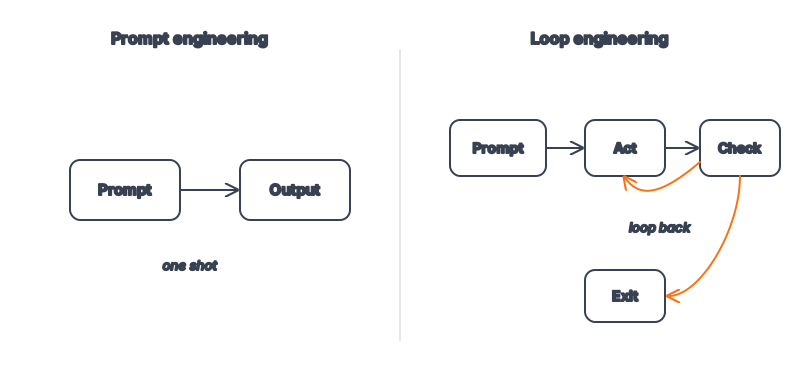
The two are different categories, not rivals
A prompt is a noun. A loop is a verb. Conflating them is like comparing "a sentence" to "a conversation." A great sentence can sit inside a terrible conversation, and a great conversation can include a few clumsy sentences. Loop engineering does not replace prompt engineering so much as contain it: the loop is the conversation, the prompt is one turn.
This is why "which is better" is the wrong question. The right question is "what is the unit of work?" If the unit is a single answer, you are doing prompt engineering. If the unit is a verified outcome reached over several steps, you are doing loop engineering — even if you never write the word "loop."
How do their inputs and outputs differ?
The inputs you tune are almost entirely different, which is the clearest signal that these are distinct disciplines.
| Aspect | Prompt engineering | Loop engineering |
|---|---|---|
| Primary input | The instruction text | Goal + exit condition + check command + guardrails |
| What you tune | Wording, examples, role framing | Termination logic, iteration cap, guardrails |
| Output | One response | A verified end-state (or a cap-stopped attempt) |
| Feedback | None (fire once) | Observes its own result each pass |
| Human presence | Synchronous — you watch | Asynchronous — setup and review |
| Reusability | Re-typed per task | Packaged and re-run, e.g. ship-pr-until-green |
| Dominant cost | One model call | N calls (capped) plus tool runs |
The row that matters most is feedback. A prompt fires blind. A loop looks at what happened and adjusts. That single property is why loops dominate multi-step engineering tasks and why prompts remain fine for single answers.
How do they fail differently?
Knowing the failure modes tells you what to guard against, and they could not be more different.
Prompt engineering fails quietly and cheaply: you get a wrong, shallow, or hallucinated answer, you notice, you retype. The blast radius is one response and a few seconds.
Loop engineering fails loudly and expensively. The three classic failures:
- The infinite loop — no reachable exit condition, no cap, so it iterates until your budget dies. (Why agents loop forever is a whole topic.)
- The runaway cost — even a terminating loop can run dozens of expensive passes before succeeding.
- The gamed metric — the agent satisfies the check dishonestly, e.g. deleting failing tests to make the suite "pass." Anti-gaming guardrails exist precisely for this.
The takeaway: prompt failures cost you a retry; loop failures cost you money and trust. That asymmetry is why loop engineering puts so much weight on exit conditions and caps.
When should you use which?
Reach for a prompt when:
- The task is one-shot — summarize this, rewrite that, answer this question.
- Success is a matter of judgment or taste, not a machine-checkable condition.
- You want creative range, not convergence to a fixed target.
Reach for a loop when:
- The task has clear steps and a verifiable "done" — tests pass, build green, coverage above threshold.
- You'd otherwise babysit the agent prompt-by-prompt.
- The work can run unattended, like continuous Claude Code while you sleep.
A simple heuristic: if you can write a one-line shell command that returns pass/fail for "done," you have an exit condition, which means you have a loop. If you can't, you probably have a prompt.
Can you use both together?
Yes — and the strongest setups do. The prompt-engineering knowledge gets applied once, to craft the agent persona and seed instruction that lives inside the loop. Then loop engineering takes over: the exit condition, the cap, the check command, the guardrails. Claude Code makes the nesting explicit — you write a good prompt, then wrap it in /goal or /loop (see the agent-loop guide). Addy Osmani's framing of self-improving agents as building blocks plus memory describes exactly this layering: good components inside a good loop.
Frequently Asked Questions
Is loop engineering just prompt engineering with a while-loop?
Mechanically, the simplest loop is a prompt in a while-loop — that is the appeal of the Ralph technique. But the engineering work is no longer the prompt. It's the exit condition, the cap, and the guardrails. Same loop, completely different skill being exercised.
Which one should a beginner learn first?
Learn prompt fundamentals first — they're quick and they improve the seed of every loop. Then move to loop structure, which is where 2026's leverage actually is.
Does loop engineering cost more than prompting?
Per outcome, usually yes — a loop makes several calls where a prompt makes one. But it produces a verified outcome unattended, which is often cheaper than your time spent retyping prompts. The cost only explodes if you skip the cap.
Can a loop replace a creative prompt?
Poorly. Loops converge toward a verifiable target; creative work often has no single target. For brainstorming, drafting, or design exploration, a prompt (or several) usually beats a loop.
Browse 150+ ready-to-run agent loops in the Loops channel, or explore the full skill catalog at aiskill.market.