Inside the Loops Channel: 152 Recipes
A tour of the aiskill.market Loops channel: 152 ready-to-run agent loops from three sources, each shipping a goal, exit condition, iteration cap, and check command.
There is a gap between understanding loop engineering and actually running a loop. The theory is simple — act, observe, decide, repeat until a verifiable exit condition — but staring at a blank prompt and inventing the right exit condition, iteration cap, and check command from scratch is where most people stall. The Loops channel on aiskill.market exists to close that gap. It is a library of 152 ready-to-run agent loops, each one shipped as a complete recipe you can paste and run.
This spotlight walks through what is in the channel, where the loops come from, and the four-part anatomy every recipe follows. If you have read the framework pieces and want to stop reading and start looping, this is the page to bookmark.
Key Takeaways
- The Loops channel holds 152 ready-to-run agent loops, aggregated from three community sources and normalized into one consistent recipe format.
- Every loop ships the same four parts — a goal, a verifiable exit condition, a max-iterations cap, and a check command — plus a paste-ready kickoff prompt.
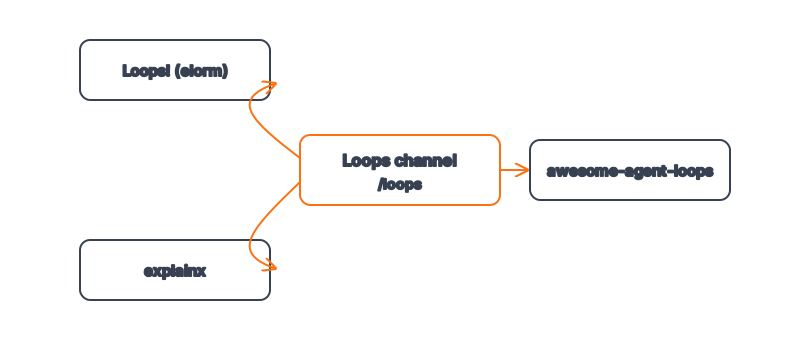
- The three sources are Loops!/elorm (41), explainx.ai/loops (99), and serenakeyitan/awesome-agent-loops (12, CC-BY), so attribution and licensing are tracked per recipe.
- Each loop has a detail page at
/skills/<slug>with the full recipe, making loops as discoverable and installable as any other skill. - The channel turns loop engineering from a concept into a catalog — you browse, copy, and run instead of designing from a blank page.
What is actually in the channel?
The channel covers the full spread of serial, verifiable work that loops are good at. A walk through the catalog turns up recipes for:
- Shipping and CI — ship-PR-until-green, build-until-green, and pr-babysitter for watching an open PR to merge-ready.
- Testing — test-until-green, kill-flaky-tests, and coverage-until-threshold for raising coverage to a floor.
- Safety and quality gates — pre-commit-guard for catching problems before they land.
Each one is a loop, not a one-shot command: it runs, checks its own output against the exit condition, and keeps going until it succeeds or hits the cap. That is the difference between a recipe in this channel and a plain prompt template.
Where do the 152 loops come from?
The channel is an aggregation, and it tracks provenance honestly. The three upstream sources each bring a different flavor:
| Source | Count | Character |
|---|---|---|
| Loops!/elorm | 41 | Curated, hand-tuned loops |
| explainx.ai/loops | 99 | The largest set; broad coverage |
| serenakeyitan/awesome-agent-loops | 12 | Community collection, CC-BY licensed |
Aggregating from three sources means breadth, but it also means the raw recipes arrived in three different shapes. The channel's job is to normalize them — every loop, regardless of origin, is reformatted into the same four-part anatomy so you never have to learn a new structure per source. The CC-BY material from awesome-agent-loops carries its attribution through to the detail pages.
What is the anatomy of a loop recipe?
This is the part worth internalizing, because it is the same skeleton you would build by hand if you followed the framework. Every recipe in the channel carries four required parts plus a kickoff prompt:
- Goal. What outcome the loop is driving toward, stated plainly — "all tests pass," "coverage ≥ 80%," "the PR is merge-ready."
- Exit condition. The verifiable signal that the goal is met. Not "looks good" — something a machine can evaluate, like an exit code or a passing check. This is the single most important field; a loop without a real exit condition either stops too early or runs forever.
- Max iterations. The safety cap that guarantees termination even if the exit condition is never reached. No cap, no mercy on your token budget.
- Check command. The objective signal run each pass —
npm test,pytest,npm run build— whose result the loop reads to decide whether to stop.
On top of those, each recipe ships a paste-ready kickoff prompt so you can go from browsing to running in one copy-paste. The loop mechanics those prompts rely on are documented in the Agent SDK agent-loop guide.
How do you go from browsing to running?
The flow is deliberately short. Open the Loops channel, find a loop that matches your task, open its /skills/<slug> detail page, and copy the kickoff prompt. Run it with Claude Code's native /loop, /goal, and /schedule primitives — the recipe already supplies the exit condition and check command those primitives need.
Because each loop is a detail page like any other skill, the channel inherits the rest of the marketplace's discovery: search, categories, and related recipes. A loop is just a skill that happens to run in a cycle, which is why it fits the catalog so cleanly.
Frequently Asked Questions
Are the loops free to use?
The recipes are available through the channel. The CC-BY-licensed loops from awesome-agent-loops carry their attribution requirement, which the detail pages preserve, so you can reuse them with credit.
Do I need Claude Code to run them?
The recipes are written around Claude Code's loop primitives, but the four-part anatomy — goal, exit condition, iterations, check command — is runner-agnostic. Any agent loop runner that can evaluate a check command can execute them.
How is a loop different from a regular skill?
A regular skill typically does one thing once. A loop runs the act-observe-decide-repeat cycle, re-checking its own work each pass until the exit condition is met. The recipe format makes that cycle explicit.
Why does the exit condition matter so much?
Because it is the only thing standing between "done" and "running forever." A vague exit condition makes the loop stop too early or never; a verifiable one lets a machine decide objectively. It is the focus of an entire framework piece.
Will more loops be added?
The channel is an aggregation of community sources, so it grows as those sources do and as new recipes are normalized into the standard format.
Browse 150+ ready-to-run agent loops in the Loops channel, or explore the full skill catalog at aiskill.market.