Tutorials & How-Tos
9 Product Design Systems to Steal
Nine standout product design systems — Stripe, Discord, Spotify, Raycast, Humane, MongoDB and more — and the one thing to steal from each for your AI agent.
Nine standout product design systems — Stripe, Discord, Spotify, Raycast, Humane, MongoDB and more — and the one thing to steal from each for your AI agent.
"Good artists copy, great artists steal" is overused advice, but it is exactly right for product design. The teams behind Stripe, Discord, and Spotify spent years and millions refining how their products look and feel, and the output of that work is sitting in plain sight on every screen they ship. The trick is knowing what to take from each — not the whole aesthetic, but the one defensible idea that makes it work — and then encoding that idea as tokens your AI agent can apply. This is the difference between cargo-culting a gradient and actually learning a system.
This piece interprets publicly indexed DESIGN.md specs and brand aesthetics; it is not affiliated with or endorsed by the companies named.
Below are nine systems worth studying, each indexed in the aiskill.market Designs category as an agent-readable spec. For each, the one thing to steal — and a link to pull the tokens.
Stripe's system is a masterclass in saying less. A tight, mostly-neutral palette, precise typography, and generous whitespace combine into something that reads as technical and premium at the same time. The lesson: trust is signalled by what you leave out. If your product handles money, data, or anything where users need to feel safe, restraint outperforms decoration. Study the full system in the Stripe design system spec, and read why fintech systems trade on restraint.
Discord proves a product can be friendly without being unprofessional. Rounded shapes, a confident blurple, illustrative touches, and playful microcopy give it warmth that most "serious" apps lack. The lesson: personality is a feature, not a liability — if your audience is communities and creators, a little play earns loyalty. Pull the tokens from the Discord design system.
Spotify's dark-first aesthetic with one electric accent green is instantly recognisable. Bold album art does the heavy lifting; the chrome stays out of the way. The lesson: a single saturated accent against a dark, neutral field creates hierarchy and energy without clutter. Grab the spec from the Spotify design system.
Raycast is built for people who live on the keyboard. Dark, sharp, tight spacing, monospace accents, and a palette that gets out of the way — everything serves speed and information density. The lesson: for power-user tools, density is respect. Don't pad a productivity surface like a marketing page. See the Raycast design system and the broader dev-tool aesthetic.
Humane's design philosophy pushed toward an interface that recedes — minimal surfaces, soft light, an aesthetic built around not demanding attention. Whether or not the hardware succeeded, the design idea is potent: sometimes the best interface is the one that disappears. The lesson: ambient, low-chrome design for products that should feel calm. Read more in Humane's invisible interface.
MongoDB's system balances developer credibility with approachability: a signature green, clean documentation-grade typography, and layouts engineered for dense technical content that still breathe. The lesson: technical products can be legible and warm; you don't have to choose between credible and friendly. Study the MongoDB design system.
LinkedIn's restrained blue, conservative type, and predictable layouts are not exciting — and that is the point. For a professional network, familiarity is trust; surprises erode confidence. The lesson: in high-stakes professional contexts, convention is an asset, not a failure of imagination.
Cloudflare pairs a warm orange with serious, technical layouts — a palette that feels approachable wrapped around content that signals heavy engineering. The lesson: you can humanise infrastructure with color while keeping the structure rigorous. Warmth and gravitas are not mutually exclusive.
Bento's namesake grid — modular, card-based, rhythmic — turns a portfolio or dashboard into something scannable and composable. The lesson: a strong grid system is a design system; get the modular rhythm right and individual components almost design themselves.
| Product | Steal this | Token highlight |
|---|---|---|
| Stripe | Restraint and precision | Neutral palette, tight type, generous spacing |
| Discord | Personality and warmth | Blurple accent, rounded radii, playful tone |
| Spotify | Dark-first contrast | One electric accent on neutral dark |
| Raycast | Density and speed | Tight spacing, monospace accents, sharp edges |
| Humane | Ambient invisibility | Soft light, minimal chrome, low contrast |
| MongoDB | Technical clarity | Signature green, doc-grade typography |
| Trust through familiarity | Conservative blue, predictable layout | |
| Cloudflare | Humanised infrastructure | Warm orange over rigorous structure |
| Bento | Modular rhythm | Card grid, consistent spacing scale |
Admiring a system changes nothing; applying it changes everything. The practical move is to take the idea you want — say, Stripe's restraint — and translate it into tokens your agent can use: collapse your palette to a few neutrals plus one accent, widen your spacing scale, tighten your type. Then hand the resulting DESIGN.md to your agent and let it build on-brand components from the stolen principle. Because all nine systems above are indexed as agent-readable specs, you can start from a real token set instead of a blank file. Don't steal nine systems at once — pick the one whose principle fits your audience and commit to it.
Copy the principles, not the literal brand. Adopting Stripe's restraint or Spotify's contrast is learning from proven work; cloning their exact logo, name, or trademarked assets is not. The token-level ideas — spacing rhythm, contrast strategy, palette discipline — are the craft, and craft is meant to be learned from.
Match the principle to your audience. Building a developer tool? Steal density from Raycast. Handling money or data? Steal restraint from Stripe. Building for communities? Steal personality from Discord. The audience decides, not your personal taste.
Less than before. If you encode the principle as tokens in a DESIGN.md, your AI agent does the application work. Your job becomes choosing the right system and reviewing the result, not hand-crafting every component.
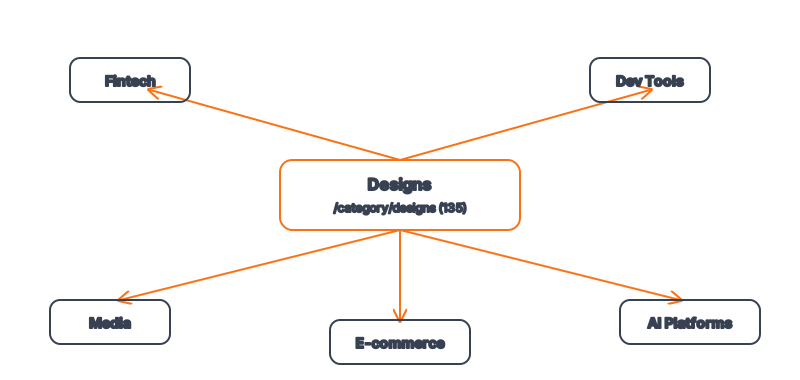
Each product above links to its spec on aiskill.market — for example the Stripe and Raycast systems — and the full Designs category indexes 135+ more.
Browse 135+ agent-ready design systems in the Designs category, or explore the full skill catalog at aiskill.market.
AI soul and personality tracing skill — gives your AI agent a consistent persona, tone, and conversational identity across all interactions. 319.2K installs.
An agent-native tutoring workspace — chat, solve, quiz, research, and math visualization in one place. MCP-compatible, 24k+ stars.
Workflow design specialist who maps complete workflow trees for every system, user journey, and agent interaction — covering happy paths, all branch conditions, failure modes, recovery paths, handoff