Loop Engineering for Solo Founders
How agent loops let one founder run serial tasks unattended — ship, test, coverage, docs — multiplying output without hiring. Which loops to start with and why.
The hardest constraint in a one-person company is not money or ideas — it is that you can only do one thing at a time. A funded team parallelizes: someone writes tests while someone else fixes the build while someone else updates docs. The solo founder does all of it sequentially, which means most of the queue just waits. Loop engineering is the closest thing to a fix, because it lets you hand the serial queue to agents that run unattended while you work on the one thing only you can do.
The mental shift is from "AI that helps me type faster" to "AI that finishes a defined unit of work without me watching." A loop runs an agent over and over — act, observe, decide, repeat — until a verifiable exit condition is met. For a solo builder, that turns the dead hours (overnight, during meetings, while you cook dinner) into shipped output. This piece is about which loops actually move the needle for a team of one, and how to start without getting burned.
This piece reflects public discussion across X and engineering blogs as of June 2026; verify primary sources before relying on specifics.
Key Takeaways
- Loops attack the solo founder's real bottleneck — serial execution — by running defined tasks unattended instead of waiting for your attention.
- Start with loops that have a hard, verifiable exit condition like test-until-green and build-until-green, where "done" is an exit code, not a judgment call.
- The leverage comes from running loops during dead hours — overnight, between calls — with tools like Continuous Claude that open and merge PRs while you sleep.
- Guardrails are non-negotiable for a one-person team — there is no second pair of eyes, so protected paths and merge gates do the supervising.
- Begin with one low-risk loop, watch it for a week, then expand — the Loops channel gives you 150+ recipes to graduate into.
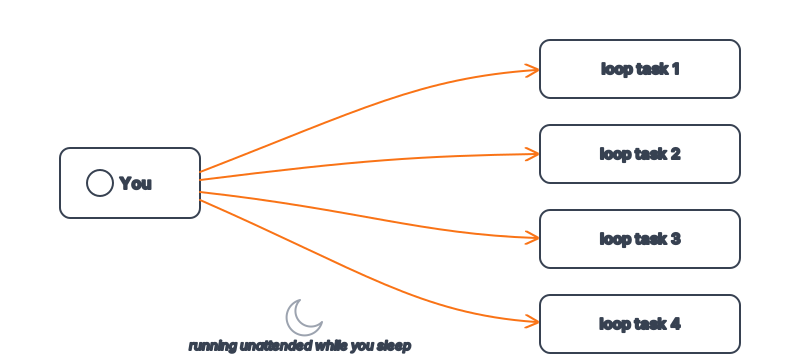
Why does the solo founder benefit most from loops?
Because the solo founder is the one person for whom serial is the whole problem. A team converts a queue of independent tasks into parallel work by assigning each to a different person. You can't. Your coverage backfill, your flaky-test cleanup, your dependency upgrades, and your docs sync all line up behind whatever you are doing right now.
Loops break that bottleneck not by making you faster but by removing you from the loop entirely for a whole class of work. A test-until-green loop doesn't need you to babysit it. It runs, checks the suite, fixes what it can, and keeps going until green or the cap. While it grinds, you are doing the irreplaceable work — talking to customers, making the calls only you can make. That is the multiplication: not 10x typing speed, but N tasks executing without your attention.
Which loops should you start with?
Not all loops are equally safe to hand off. The right first loops share one trait: a hard, machine-verifiable exit condition, so there is no ambiguity about when they're done and little room to go wrong.
| Loop | Exit condition | Risk | Why start here |
|---|---|---|---|
| test-until-green | Suite passes | Low | Objective, fast feedback |
| build-until-green | Build exits 0 | Low | Can't fake a green build |
| coverage-until-threshold | Coverage ≥ N% | Low | Bounded, measurable |
| kill-flaky-tests | 5 consecutive green runs | Medium | High payoff, needs guardrails |
| ship-pr-until-green | All CI green | Medium | Touches the merge path |
Begin at the top of that table. The exit conditions are unambiguous, the blast radius is small, and a pre-commit-guard loop can sit in front of everything as a safety net. Save the merge-path loops for after you trust the cheap ones.
How do you turn dead hours into shipped work?
The unlock for a solo founder is time, not just attention. You have roughly 16 hours a day when you are not actively coding — and a well-guarded loop can run in most of them. The pattern:
- Overnight serial runs. Point Continuous Claude at a queue of small changes — dependency bumps, coverage modules — and let it open, CI-check, and merge PRs while you sleep. Its repo is at github.com/AnandChowdhary/continuous-claude.
- Between-meeting bursts. Kick off a test-until-green loop before a call; review the diff when you're back.
- Scheduled maintenance. Use Claude Code's
/scheduleprimitive for a nightly docs-sync or coverage sweep that just happens.
The compounding effect is real: each unattended hour clears part of the serial queue, so the work that does need you isn't stuck behind chores. The Ralph technique that underpins these runs is described well in Geoffrey Huntley's writeup.
What goes wrong without guardrails — and you have no backup?
Here is the asymmetry that should make a solo founder cautious: a team has a second person who notices when an agent deletes a test to make the suite pass. You don't. Your guardrails are your supervision. The non-negotiables:
- Protected paths so a loop can't "fix" failures by deleting tests or critical files.
- A coverage floor so the suite can't shrink its way to green.
- A max-iterations cap so a confused loop can't burn your token budget all night.
- A human merge gate on anything touching production — loops make PRs mergeable; you hit merge.
These are the same anti-gaming protections covered in exit conditions are the heart of every loop, and for a solo team they matter double. Skip them and you wake up to a green suite that's green because the tests are gone.
How do you scale from one loop to many?
Start with exactly one. Pick test-until-green, run it for a week, and watch what it does — read the diffs, confirm the guardrails hold, build trust. Once you trust it, add a second loop with a similarly hard exit condition. Then a third. The Loops channel gives you 150+ recipes to graduate into, each with the goal, exit condition, iteration cap, and check command already specified, so expanding is a matter of copy-paste, not design-from-scratch.
The end state is a small portfolio of trusted loops handling your serial chores while you spend your scarce attention on the work that compounds. That is loop engineering for a team of one: not replacing yourself, but cloning the parts of yourself that were only ever bottlenecks.
Frequently Asked Questions
Won't running loops unattended just create a mess I have to clean up?
Only without guardrails. A loop with a verifiable exit condition, protected paths, and a max-iterations cap produces bounded, reviewable output — usually PRs you approve in the morning rather than a mess.
What's the cheapest loop to start with?
A test-until-green or build-until-green loop. Both have exit conditions a machine can verify objectively, low blast radius, and fast feedback, which makes them ideal for building trust.
How much does running loops overnight cost in tokens?
It depends on iteration count, which is exactly why the max-iterations cap exists. Cap the loop and you cap the cost; an uncapped loop is the only one that can surprise your bill.
Do I still need to review what the loops produce?
Yes. For a solo founder, reviewing the morning's PRs is the supervision a teammate would otherwise provide. The loop does the work; you keep final judgment, especially on the merge path.
Can loops replace hiring entirely?
They multiply your serial output, not your judgment. Loops handle the tedious, verifiable work a team would parallelize; they don't make the product and customer decisions only a human founder can.
Browse 150+ ready-to-run agent loops in the Loops channel, or explore the full skill catalog at aiskill.market.