How a Tweet Kicked Off Loop Engineering
In June 2026 a wave of X posts popularized the term loop engineering almost overnight. Here is how the discourse spread and why the idea resonated with agent builders.
Sometime in early-to-mid June 2026, a phrase that had been floating around agent-engineering corners snapped into focus. "Loop engineering" went from a thing a few practitioners said to a term people argued about on the timeline, wrote threads explaining, and started putting in their bios. The shift was fast enough that a lot of people experienced it as a single moment rather than a trend — one of those weeks where a name suddenly exists for something everyone had been doing without one.
This is a short history of that moment: what was being said, who was part of the conversation, and why an idea this simple spread this quickly. It is also a caution against the way these origin stories usually get told, where one heroic tweet gets credited for a shift that was actually months of quiet groundwork.
This piece reflects public discussion across X and engineering blogs as of June 2026; verify primary sources before relying on specifics.
Key Takeaways
- No single tweet "invented" loop engineering — public discussion across X and engineering blogs converged on the term over several weeks in mid-2026, building on existing practice.
- Peter Steinberger's posts helped spark the wider X conversation, and the framing spread through the broader Claude Code and agent-building community.
- The idea resonated because the practice already existed — people had been running Ralph-style loops and
/loopcommands; the term just gave it a name. - Naming a practice changes how a field treats it — once "loop engineering" existed, people could teach it, hire for it, and argue about it, the way they had with prompt engineering.
- Origin stories compress messy reality — be skeptical of any clean "it started here" narrative, including this one.
The state of things before the name
By spring 2026, the raw materials were all in place. Coding agents could run for long stretches. Claude Code had shipped loop-shaped primitives. The Ralph technique had been written up and was being copied. Curated directories of reusable loops were starting to appear. People were absolutely doing loop engineering — they just called it "running the agent in a loop," "babysitting the PR," "the Ralph thing," or nothing at all.
What was missing was a shared label. And labels matter more than engineers like to admit. A named practice can be taught, hired for, debated, and improved. An unnamed one is just a bunch of people independently rediscovering the same tricks. The gap between "I have a clever workflow" and "this is a discipline called X" is mostly linguistic, and crossing it tends to happen suddenly.
How does a term actually go viral on X?
The mechanics here are worth understanding because they repeat. A term like this does not spread because one post is brilliant. It spreads because a cluster of credible people start using it within a short window, and the timeline interprets that cluster as a signal.
Public discussion suggests Peter Steinberger's posts were among those that helped kick off the broader X conversation in this period. From there the usual amplification dynamics took over: practitioners who had been doing the work recognized themselves in the term and adopted it, threads explaining "what is loop engineering" appeared, and the phrase crossed from the agent-engineering niche into the general developer timeline.
Crucially, the people spreading it were not strangers to the idea. They had real workflows to point at. That is the difference between a term that sticks and a buzzword that evaporates — there was substance underneath, so the name attached to something real rather than floating free.
Why the idea resonated
Three things made loop engineering land harder than a typical bit of jargon.
First, it described a felt pain. Everyone who had tried to get an agent to do something substantial had hit the same wall: one prompt is not enough, and babysitting the agent by hand does not scale. "Loop engineering" named the solution people had been improvising.
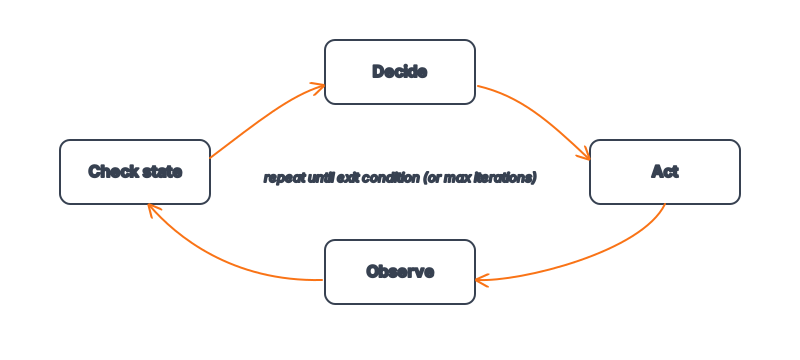
Second, it had a clean contrast with the thing it was succeeding. "Prompt engineering" had defined the previous era — crafting the perfect single instruction. "Loop engineering" reframed the job as designing the system around the agent: the exit condition, the iteration cap, the check command. That contrast is genuinely useful, and we unpack it in Loop Engineering vs Prompt Engineering.
Third, it was immediately actionable. Within days of the term spreading, people had concrete building blocks to point to. Addy Osmani's framing of self-improving agents as a handful of building blocks gave the discourse intellectual structure, which we cover in Addy Osmani's 5 Building Blocks. A term you can act on the same afternoon spreads faster than one you can only nod at.
| Phase | Roughly when | What characterized it |
|---|---|---|
| Latent practice | Early 2026 | People running loops without a shared name |
| Spark | Early-to-mid June 2026 | Influential X posts use and frame the term |
| Amplification | Mid-June 2026 | Threads, explainers, bios adopt "loop engineering" |
| Consolidation | Late June 2026 onward | Tooling, directories, and content organize around it |
The reading list behind the moment
Much of what spread in June 2026 was a shared reading list as much as a term. If you want to trace the conversation back to primary sources rather than secondhand threads, these are the pieces people kept linking:
- Addy Osmani — Loop Engineering
- Firecrawl — Loop Engineering
- Oracle — What Is the AI Agent Loop?
- OpenAI — Harness Engineering
- Birgitta Böckeler (martinfowler.com) — Harness Engineering for Coding-Agent Users
- Data Science Dojo — Agentic Loops: From ReAct to Loop Engineering
- Mem0 — Loop Engineering: Memory-First Design
- Papers — Agentic Harness Engineering and From Agent Loops to Structured Graphs
Treat these as the spine of the discourse, not a canon — the field is moving fast enough that the reading list is still being written.
What to be skeptical of
The tidy version of this story — "a tweet kicked off loop engineering" — is the title of this very article, and you should treat it with suspicion. Origin myths flatten reality. The honest account is that many people contributed, the practice predated the term, and the "moment" was really a convergence that felt instantaneous from the inside.
Be wary of anyone who attributes the entire shift to a single named person or a single post, including precise claims about who said what first. Public attribution on a fast-moving timeline is unreliable, screenshots get edited, and memory rewrites itself. When you see a confident origin story, ask for primary sources and timestamps before you repeat it.
Frequently Asked Questions
Did one specific tweet invent loop engineering?
No. The term emerged from public discussion across X and engineering blogs over several weeks in mid-2026, building on practices like the Ralph technique that already existed. The "single tweet" framing is a useful narrative shortcut, not an accurate history.
Who popularized the term loop engineering?
Public discussion suggests Peter Steinberger's posts helped spark the broader X conversation around June 2026, and the framing spread through the wider Claude Code and agent-building community. No single person should be credited as the sole originator.
Is loop engineering just a rebrand of prompt engineering?
Not quite. It shifts the focus from crafting one perfect instruction to designing the system around an agent — exit conditions, iteration caps, and check commands. We compare them directly in Loop Engineering vs Prompt Engineering.
Why did the term spread so fast?
It named a pain everyone felt, contrasted cleanly with the prior "prompt engineering" era, and was immediately actionable with concrete building blocks and tools. Terms that are useful the same afternoon spread faster than abstract ones.
How can I verify claims about who started the trend?
Look for primary sources with timestamps rather than secondhand summaries. On a fast-moving timeline, attribution is unreliable. Treat confident origin stories — this one included — as starting points for your own checking, not settled fact.
Browse 150+ ready-to-run agent loops in the Loops channel, or explore the full skill catalog at aiskill.market.